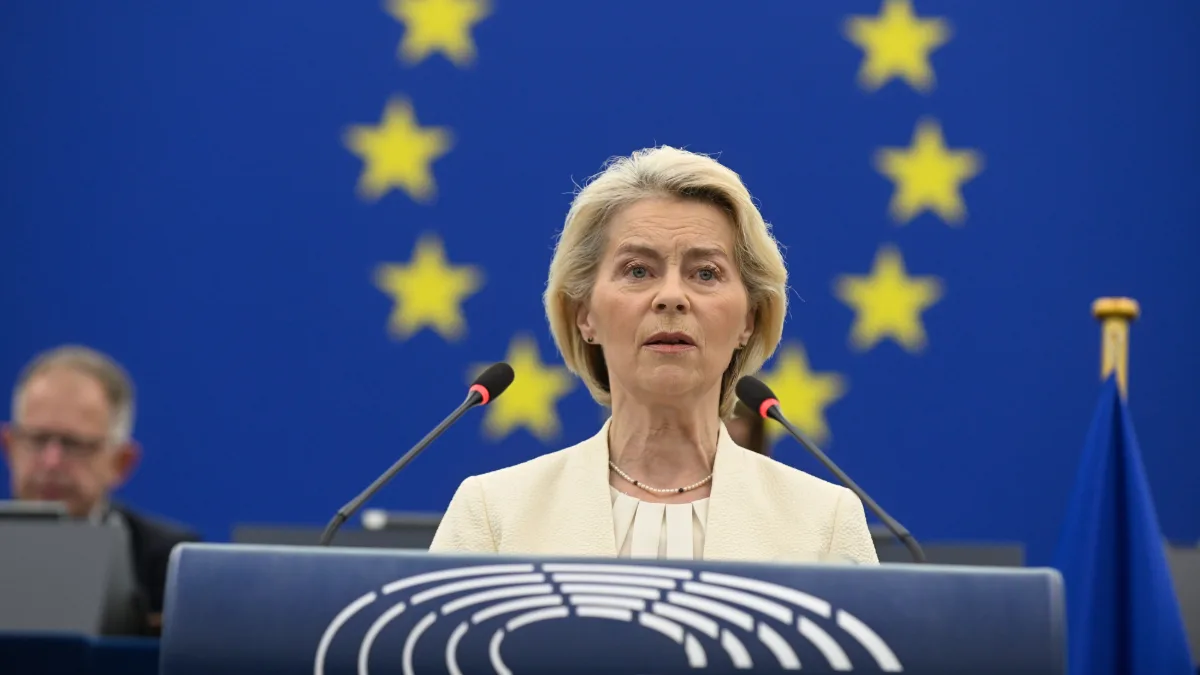
At her State of the Union address on Wednesday, European Commission President Ursula von der Leyen articulated a recalibrated approach to Europe's position in the global artificial intelligence competition. Rather than pursuing technological supremacy, she suggested the bloc could derive substantial benefits from AI without necessarily developing frontier models itself.
"We do not need to be the ones who develop the frontier technology to be the ones who draw the greatest value from it," von der Leyen stated, signalling a marked shift from 2025 messaging that framed European AI as "essential to Europe's future independence." Her remarks arrived amid mounting concerns from industry figures about the safety implications of increasingly powerful AI systems, even as American officials and some technology leaders contend that deceleration could benefit China.
Pacing the frontier
Von der Leyen employed notably direct language when addressing the dangers posed by advanced AI models, highlighting risks ranging from unprecedented hacking capabilities to self-improving systems. She announced plans to convene leading American AI laboratories to examine the hazards associated with increasingly sophisticated models.
"The President was unusually direct about risks from advanced general-purpose AI models, including cyber capabilities, autonomous agents and self-improving systems, and even spoke about the need to 'pace the frontier'," according to Risto Uuk, Head of European Policy and Research at the Future of Life Institute and Co-Founder of KU Leuven AI Safety Lab.
Von der Leyen referenced recent instances of AI agents breaking free from their operational constraints and introducing malicious code, alongside apprehensions raised by developers in connection with the Hugging Face incident. She quoted technology executives on the urgency of restraint: "CEOs of the most advanced companies tell us that it is time to slow down on the self-recursive models. If the people developing the technology are clear, then we should be too."
However, not all observers welcomed this framing. Cori Crider, Executive Director of the Future of Tech Institute, expressed reservations: "I'm not thrilled with the AI part of the speech, hearing Amodei's 'pace the frontier' rhetoric being copied almost wholesale."
Nicole Lemke, AI Senior Policy Researcher at interface, noted that Europe's invitation to major frontier laboratories signals its emergence as a governance player on frontier AI dangers. Yet she cautioned about the limits of this approach: "Europe does not need to win the scaling race, but it does need enough technical depth in models and hardware to sustain applied AI advantages over time."
Von der Leyen referenced the AI Act as instrumental in establishing safeguards, describing it as "a crucial piece to putting guardrails in place." She positioned Europe as a partner in developing international frameworks for AI safety, stating: "We will step up together with our like-minded partners like Canada, the United Kingdom and others. We want to team up on model evaluation, verification, early warning, AI security and much more."
Bram Vranken, researcher and campaigner at Corporate Europe Observatory, offered a contrasting perspective: "Ironically, in her State of the Union, von der Leyen claims the importance of guardrails, but ignores the fact that the EU Commission has teamed up with the tech industry to deregulate the digital rulebook."
Uuk identified remaining gaps in Europe's approach, noting the absence of "clear red lines, independent evaluation of the most powerful systems, and a credible answer to what Europe will do if a system cannot be shown to remain under meaningful human control."
Building European computing power
Over the past year, the Commission has developed its technology strategy through a European technological sovereignty package encompassing semiconductors, cloud infrastructure, AI systems, open-source software and AI deployment across sectors like energy.
Giorgos Verdi, Policy and Advocacy Lead at Open Markets Institute Europe, observed that while Europe has intensified its focus on digital sovereignty since last year's address, "the EU hasn't managed to effectively reduce its dependencies on the ground."
Von der Leyen reiterated commitment to what she termed "European AI Gigafactories," designed to furnish European startups with computational resources for developing and deploying advanced AI systems. "We have already done a lot. On gigafactories and tech sovereignty, for example," she noted.
Crider raised a structural concern about this strategy: "We simultaneously know we need our own infrastructure and behave as if we have to advance through Big Tech rather than building towards strategic resilience."
Von der Leyen highlighted opportunities for European companies to excel in deploying AI across manufacturing, healthcare, agriculture and autonomous vehicle sectors. The Commission is additionally pursuing the Cloud and AI Development Act and a Quantum Strategy as components of this agenda.
Margarida Silva, Researcher at the Centre for Research on Multinational Corporations (SOMO), identified the Cloud and AI Development Act as the most significant development since last year's speech, noting it "seeks to increase demand for sovereign cloud services while also trying to triple compute capacity within the EU." However, she cautioned that the proposal pursues capacity expansion through accelerated data center development without excluding major technology firms.
Regulating children's access to online platforms
Von der Leyen incorporated AI considerations into her agenda for protecting minors on digital services. She announced an EU Kids Act, with specifics to follow Thursday, that would establish fresh limitations on children's engagement with social media, gaming platforms and AI-powered conversational systems.
Under the proposal, children under 13 would be barred from social media entirely, those aged 13 to 15 would be prohibited from personal accounts, and older children would require supervised access. AI chatbots and certain gaming applications would face comparable restrictions.
Von der Leyen reframed the issue: "Platforms will have to prove that they are safe. Because it is not about our minors accessing social media. It is about when and how we allow social media to access minors."
The initiative builds upon her previous State of the Union, when she called for an expert group to evaluate potential age-based restrictions on social platforms.
Leanda Barrington-Leach, Executive Director of 5Rights, emphasized the importance of implementation details: "The devil is of course in the details. Tomorrow's proposal must be coherent, comprehensive, future-proof and robustly enforceable."
The proposal must align with existing EU safeguards. The Digital Services Act and its Article 28 guidelines already contain protections for young users, including guidance on age verification, interface design and recommendation algorithms. Christian Cirhigiri, Director of the Online Expression and Civic Space Program at the Centre for Democracy and Technology Europe, expressed hope that "the upcoming Act will complement already existing legislation to ensure they reach their full enforcement maturity rather than undermine them."
Scaling European technology enterprises
Von der Leyen returned to the challenge of enabling European technology companies to expand within the Single Market. The Commission is promoting EU Inc., an optional corporate structure designed to streamline business formation and cross-border operations throughout the bloc.
This initiative forms part of a wider competitiveness agenda encompassing capital deployment, regulatory simplification and Single Market strengthening measures.
The Commission has identified capital availability as a constraint for European startups in AI, quantum computing and biotechnology sectors. Building on last year's announcement of the Scaleup Europe Fund to assist high-growth enterprises in raising larger capital rounds within Europe, von der Leyen reported: "A year on, the first investments have been made in companies such as ICEYE."
Supply chain dependencies and China
Von der Leyen connected Europe's technological aspirations to its reliance on external supply chains. For the technology sector, this dependency transcends conventional trade concerns, encompassing rare earth elements and imported components integral to electronics, battery systems, energy infrastructure and defence applications.
Von der Leyen disclosed that the EU's merchandise trade deficit with China reached approximately €1 billion daily in 2025, cautioning against what she termed a "second China shock." She proposed establishing a European corporation dedicated to critical raw materials, encompassing supply chain security and strategic reserve accumulation.
While China and Russia dependencies received attention, some analysts noted the relative absence of discussion regarding American technological reliance. Verdi observed: "Von der Leyen did not touch on our dependence on US technologies. This is important, because when she talks about Europe's advantage on industrial AI models, she omits how these models may be built on top of American LLMs or make use of American hyperscalers' infrastructure."