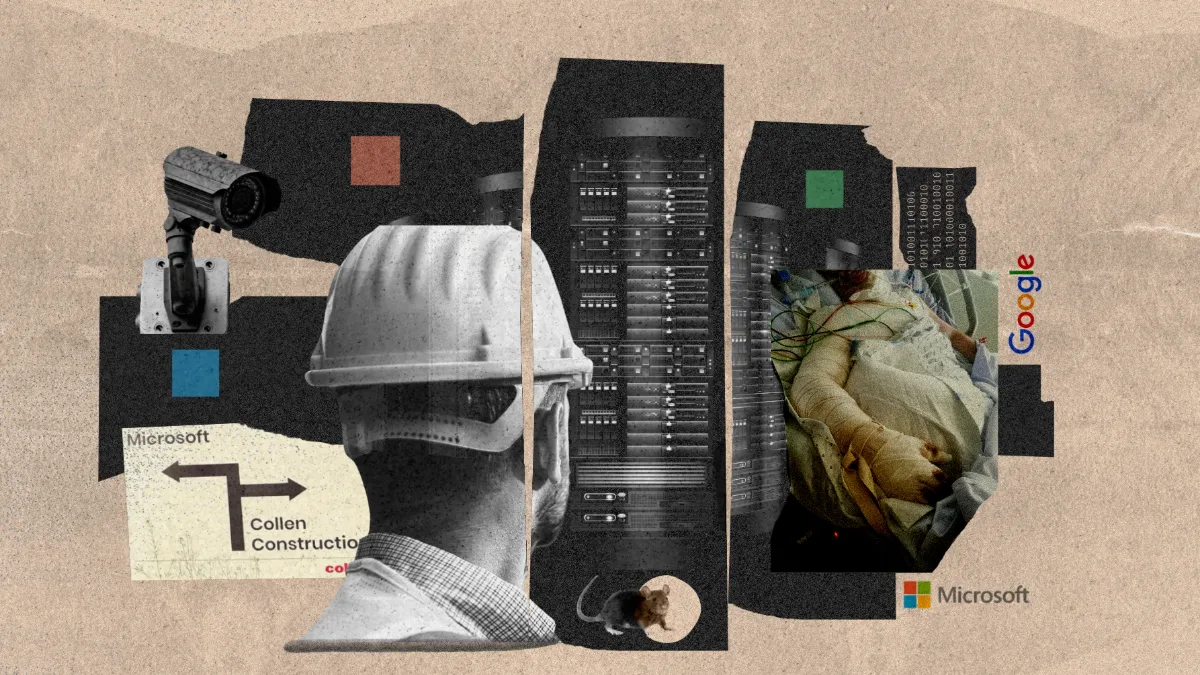
A coordinated five-month investigation spanning nine countries by Investigate Europe and partner media outlets has uncovered widespread labor abuses at data center construction sites across the continent, where tens of thousands of migrant workers are building the physical backbone of Europe's AI ambitions.
A catastrophic accident in Belgium
In March at Google's GBL-6 data center in Saint-Ghislain, Belgium—part of a €5 billion campus expansion—electrical tester Sandu Dumitrescu faced a choice after nearly 10 hours on shift. His manager requested two final electrical tests before he left. Dumitrescu, 34, working on a week-to-week contract through Dutch recruitment firm Wanted and supervised by Estonian managers employed by Irish subcontractor Dornan Engineering, felt unable to refuse. "I had no choice," he recalls. "People have been fired after saying no."
The work involved testing electrical wiring integrity—a task he had performed many times. A protective suit sat locked in an equipment room 15 minutes away. With people waiting and the trip adding time to an already extended shift, Dumitrescu decided to proceed without it. Managers confirmed the lines had been de-energized. The first test proceeded normally. On the second attempt, while holding insulated tongs to connect cables, the lines were live.
Four hundred volts and 12,000 amps struck his face and right side in milliseconds. A colleague below the platform heard "a loud bang, saw a lot of smoke, and saw [Sandu] screaming in pain." Dumitrescu lost his vision immediately. "I went completely blind," he says. "I told the managers three times that I could not see." According to the witness, managers fled while Dumitrescu writhed on the ground, his body blackened.
Hospital records show the arc flash burned 12 percent of his body, with second-degree burns across his face and neck and third-degree burns on his right shoulder and fingers. After five days in an induced coma and subsequent surgery, he woke in intensive care. "My entire body felt like a white-hot blister," he recalls. "It was so much pain. The human heart cannot comprehend it."
Two days after regaining consciousness, Google's regional director, a Dornan representative and his recruiter visited his hospital bed to take statements. Despite repeated formal requests, Dumitrescu has never received his accident report. Belgium's federal labor inspectorate closed its investigation in October, finding no wrongdoing, though Dumitrescu was never directly interviewed. A month after the accident, Wanted messaged asking if he knew people interested in tester positions.
A Google spokesperson stated: "Our supplier code of conduct and contracts require all suppliers to comply with local labor laws and uphold safe, healthy working conditions. We maintain active dialogue with union leaders and trade groups, and are committed to providing transparent information about our workplace."
Wanted said: "As an employer, we can, will and should be held accountable by the proper authorities. Although we agree that freedom of speech and press is a great asset, we cannot comment on the content besides the fact that your statements or claims are not correct."
The investigation found Dumitrescu's case far from isolated. In extensive interviews with migrant workers at flagship sites where major US technology companies operate across Sweden, Norway, Belgium and the Netherlands, reporters documented debilitating injuries, substandard housing, unreported disease outbreaks, unpaid wages and exploitative employment practices. Testimonies are supported by health records, pay slips, messages, photographs and videos.
The data center construction sector is experiencing an infrastructure expansion unprecedented in recent decades. Individual sites can employ up to 2,000 workers across dozens of contractors, with approximately a quarter of a million people working on European sites daily. By 2030, the industry forecasts €100 billion in European data center investments. Yet construction remains the most dangerous economic sector in the EU, with 776 deaths recorded in 2024—nearly a quarter of all fatal workplace accidents.
'Thank you for working safely'
Adrian, a 45-year-old construction worker at a Microsoft data center site near Gävle in Sweden, described a different kind of hazard. "I wake up at two in the morning, and I can hear rats eating, moving in the walls. This house is full of rats. When I put pizza in the oven, they are running in the walls near me," he says. Video he shared shows a large rat scurrying across a hallway into an electrical storage room. In August messages to the housing manager, Adrian pleaded for action. The response: "Brother, I understand. But I have to wait for these other companies to come in and remove them, I can't come in alone and just pull them out of the walls…"
Two hours northwest of Stockholm, Microsoft is executing a 130-hectare, 33.7 billion Swedish kronor (€3 billion) expansion launched in June 2024 to scale AI data center capacity. Irish contractor Collen oversees the build-out, managing a network of subcontractors. One major subcontractor, Irish-owned Benbau, employs hundreds across Europe in site management, concrete and carpentry. Workers are housed 20 minutes away in modular units managed by Benbau.
For months, Adrian and colleagues reported vermin infestations, broken ventilation and absent heating during sub-zero Swedish winters, with no resolution. One 50-year-old Romanian worker, diabetic, shared images of toes that lost circulation from poor work boots issued by Benbau; he required amputation months later. The 40-room modular housing unit accommodates 24 people to one kitchen and 14 men to a single bathroom, with a boarded-up hole where rats entered and a sealed bathroom window.
In February, a Romanian worker became severely ill and was hospitalized with active tuberculosis, confirmed by medical records reviewed by investigators. Others subsequently showed similar symptoms. Benbau initially informed only a few men sharing close quarters with the infected worker, telling them testing was optional. Freedom of information requests to Sweden's work authorities and Public Health Agency revealed no outbreak had been reported.
The county medical officer in Gävle confirmed only one case was reported in March to the national health authority. In Sweden, tuberculosis requires mandatory contact tracing, which workers claim never occurred. Eight Benbau workers in the same housing and union representatives believe 10 to 12 men contracted the disease.
Mihai, 60, tested positive for tuberculosis according to hospital records. Benbau offered to transfer him and others they claim were infected to a Microsoft site in Denmark. Considering his age, Mihai declined. In May 2026, witnesses report vans arrived relocating workers to Denmark; two witnesses say many who departed had tested positive for tuberculosis. Some diagnosed with latent tuberculosis reported experiencing symptoms weeks prior. An entire concrete crew reportedly left that day. Approximately 40 men departed, according to witnesses.
Danish construction union 3F Byggegruppen records show around 45 posted workers arriving at the Microsoft site in Høje Taastrup around that time. No further record of these men exists despite 3F's efforts to contact Benbau. One 50-year-old worker who moved into a new bedroom said he feared speaking to media: "that I would be sent to Denmark too."
'They rule on mental terror'
Workers describe a shift in working conditions over the past two years as AI infrastructure acceleration intensified. "It now feels like we are in the army service," one Romanian worker told investigators. "They rule on terror, mental terror."
Workers report daily harassment and constantly shifting rules, with language barriers compounding difficulties. To monitor safety, Collen introduced a football-style violation system implemented by Benbau: 'yellow cards' and 'red cards' for perceived infractions. "Carded" workers describe hours-long interrogations by managers, followed by forced written confessions to workplace incidents they claim they did not commit.
"We are forced to sit in a room and confess to things we had not done," one worker claims. Following violations, workers attend 'reinduction' training in English rather than their native Romanian. Under a program called 'Goodsaves,' workers must report site or worker issues twice weekly. Failure triggers threats of wage deductions and extra training, according to text messages reviewed by investigators.
"These are control mechanisms," says one worker. "On Friday there's the first message: 'You have by 12 o'clock to finish your [reports]'. Then after 12 the threats begin: 'You need to do your [report], do you want to work on Saturday?' Then the last threat is: 'We are going to cut the [missing report] out of your wages.'"
A former Romanian manager who worked for Benbau refused to participate in interrogation sessions as a translator. He believes the written confessions were "designed to humiliate" colleagues. "In that atmosphere, I couldn't continue seeing people working like this," he says. "I did not want to be afraid of someone who is forcing men to work 13 hours a day. I talked with my wife and I said: 'This is the moment we need to go back to our country.'"
Wage theft and the erosion of Swedish labor standards
Over 30 workers provided hundreds of pay slips to investigators, many documenting 60-hour weeks with no overtime compensation, apparently violating Swedish labor law. Some workers claim they have received no paid holiday as required under Swedish law for five years. Solidariska byggare, a union group, has sought to recover years of backpay for migrant workers at Gävle paid up to 30 percent less than Swedish counterparts.
Sweden has historically operated under a self-regulated labor market where trade unions and employer organizations establish wages and conditions through collective agreements rather than state-mandated law. Unions now say this model is eroding and cracking open.
As data center sites proliferate, tracking the lengthening chain of subcontractors becomes increasingly difficult. Freedom of information requests to Sweden's Work Environment Authority reveal 148 firms working under Collen at Gävle, including 28 direct subcontractors. Single subcontractors can manage more than a dozen firms beneath them.
In Sweden, it is customary, though not legally required, for clients to demand collective agreement clauses in public procurement tenders. When Collen began work in 2019 on the Microsoft Gävle site, no such agreement existed. Soon after, many subcontractors, including Benbau, also bypassed collective agreements with unions.
With accelerating US multinational expansion into Europe, many companies are willing to forgo collective agreements entirely, according to unions. Foreign workers unfamiliar with local laws, combined with contractors setting terms, create conditions for rapid inequity.
"It is a very clear picture," says Pelle Sunvisson, leader at Solidariska byggare. He describes what he observes handing out leaflets outside the Microsoft Gävle site: "At 4 o'clock there is a wave of Swedish workers. They are typically electricians working with Swedish companies that have Swedish collective agreements. If you wait an hour, then there is a smaller group of white-collar Irish workers leaving, and then around six you get some Polish, Romanian, Serbian workers. Then at seven or eight o'clock, all the workers [from outside Europe]."
Dozens of Romanian workers at Benbau have recently joined Solidariska byggare. Negotiations with Benbau to obtain unpaid wages recently stalled, and the union considered a blockade, accusing the company of withholding nearly 10 million Swedish kronor (€900,000) in wages and back pay for 78 men.
"Since migrant workers don't know the system, there is a big black hole in the Swedish model, where it becomes like a lawless territory," says Sunvisson. "We have people cheated, who don't get their salaries, even the low salary that has been promised. Some people [in the construction industry] are working five months for €500, with physical and verbal violence."
Data from freedom of information requests to the Swedish Work Environment Authority show that since 2019, Irish company Winthrop has been fined 12 times for failing to meet core reporting requirements for foreign workers at Swedish data center sites. One unannounced 2021 inspection noted 15 different nationalities at Winthrop on the Microsoft Sandviken site.
Since 2021, the Work Environment Authority has opened 50 cases into data center sites involving Microsoft and Irish firms Winthrop, Collen and Mercury. Records from 2021 to 2026 identify numerous risks, including serious danger of workers being struck by vehicles and machines falling into excavations. Other inspections documented lack of fixed fall protection, including suitable guardrails and platforms. A 2024 Collen inspection resulted in an immediate stop-work order and conditional fine for inadequate fall protection measures, with authorities stating the company's lack of protection posed immediate and serious danger of personal injury.
In October 2021, a forklift ran over a supervisor's foot at Collen's Gävle site. The worker required surgery. Collen's incident report found the wrong machine had been used, the driver lacked formal certification and the lift plan was incomplete, yet it had been signed off. The subcontractor listed both the injured man and driver as self-employed. The Work Environment Authority found no grounds to report the employer to prosecutors.
When approached, Collen declined to address specific issues but stated the allegations were "wholly inconsistent with Collen's values, policies and the standards to which we hold ourselves and those with whom we work." The company added: "We are committed to ensuring that every Collen site is a safe, healthy and respectful place to work, where everyone is treated with dignity and their fundamental human rights are protected. We expect the same throughout our supply chain and have zero tolerance for any conduct inconsistent with these principles."
Access denied: Union exclusion across Europe
Beyond Sweden, similar patterns emerge. Pyotr Zaitsev, an engineering manager, worked on data center sites for an Irish construction firm in Germany until 2019. Highly experienced in managing electrical installations and supervising subcontractors, he regularly exceeded his contracted hours. "I had a contract for 40 hours a week on paper," he says, "but in reality, I was actually working 60 hours minimum, up to 80 hours from time to time."
Hearing conditions were better in the Netherlands, he joined several large Winthrop sites. After 18 months, pressure intensified to match his former employer, he claims, resulting in "severe burnout." In 2021, after a full shift, he fainted on site from overexertion. In a subsequent email to Winthrop's HR, he informed them he had gone to the hospital without specifying why. Winthrop said they had no record of such an incident, stating: "It is company policy that all adverse events must be reported, investigated and comprehensively recorded."
He also raised workplace safety concerns. A serious incident involved a Romanian subcontractor: "There was a [mobile elevated working platform]," he describes, "the [worker] was distracted and he was using the remote control and he drove over his [own] leg." Winthrop said they conducted analysis and the employee returned to work the next day, adding that they adhered to all applicable laws. A Winthrop spokesperson stated: "Winthrop is committed to maintaining the highest standards of health and safety across their projects, ensuring our people, partners and clients can operate in a safe and supportive environment. We place safety at the heart of project delivery."
Zaitsev has been on sick leave since 2023. In May 2025, a Dutch government employment body ordered Winthrop to provide extended sick pay until May 2026, finding the company had not fulfilled obligations to help him return to work. Winthrop stopped paying him in September 2025. A Winthrop spokesperson said: "Despite repeated efforts to re-integrate the employee since he left in 2023 following a non-work-related accident outside the workplace, no progress was made in terms of the employee resuming work."
Accessing data center sites to inspect worker conditions proves challenging, according to FNV, the Netherlands' largest trade union. Its representatives claim they attempted to access the Winthrop site in Schiphol-Rijk in September to speak with workers. At the gate, a Winthrop employee refused entry, reportedly stating: "Beyond this gate, it's not the Netherlands… I am not allowed to let you in by upper management." FNV claims it has made several unsuccessful attempts, including an email request in summer 2026, to visit the Winthrop-Microsoft site.
A Winthrop spokesperson said union representatives were granted access through "pre-arranged protocols" across their data center sites, adding: "Any suggestion that unions are denied access to sites is false and misleading." The vast majority of Dutch construction companies are bound by collective labor agreements allowing union access. Foreign companies are not automatically covered.
Belgian, Swedish, Danish, Finnish and Italian unions all reported trouble accessing data center sites or complete exclusion. Lotta Sjölander, a representative at Sweden's national trade union Byggnads, the country's largest, says representatives have been unable to access Microsoft sites in Gävle and Sandviken "from the very beginning."
The Danish construction union 3F Byggegruppen, comprising 56,000 members, prides itself on achieving worker parity. Yet Christian Foli Jensen, a 3F union consultant, says gaining site access is increasingly difficult. "The clients don't follow the normal way to do things, like on construction sites in Denmark. The sites are more closed than a state prison," he says.
Jussi Sakari from the Finnish union Rakennusliitto says they normally gain site access, but with main contractors recently operating in Finland, it has taken longer. "Things were more difficult with Winthrop at first," Sakari says. The union has documented reported issues across Finnish sites. "Alongside wage theft, forced or bogus self-employment has emerged as a major issue in recent years," he says.
A similar pattern appears throughout Europe, says James McCabe, a regional representative for Unite the Union, representing over 1.2 million workers across Ireland and the UK. "Everywhere we've encountered Irish data center contractors at tech giant data center sites, we've learned of lack of normal and meaningful union access, difficulty accessing information as well as serious concerns of labor crimes and exploitation of workers. Everywhere," he says.
In Pero, on Milan's outskirts, an Amazon data center is under construction across two sites with two general contractors. On one site, unions have never been permitted to speak with workers. Investigators were present at one such attempt in September. According to Carlo Rioldi from the Italian Confederation of Workers' Trade Unions, many workers fear speaking to unions about experiences. "Workers don't tell unions about their problems for fear of retaliation and because they often don't know their rights," Rioldi said.
An Amazon spokesperson said: "We expect suppliers of goods and services for Amazon to adhere to our supply chain standards... informed by leading international standards and frameworks developed by the United Nations and the International Labor Organization."
Enforcement gaps and regulatory response
Europe's data center construction sites expose a major enforcement gap. With fewer than 140 staff in 2025 supporting labor law enforcement across the EU, the European Labor Authority remains overstretched and unable to address mounting issues. In a reply to investigators, it acknowledged having "no independent inspection or enforcement powers" and being unable to "enter workplaces to collect evidence, investigate cases or impose sanctions."
Several fatal accidents have been reported at data center sites recently. In the UK, a general contractor died while working on a London development last year. Another fatality occurred in 2024 at an electrical substation being built for a Microsoft data center in the capital. Serious accidents have also been recorded this year at projects in Sweden, Norway and Belgium. Exploitative labor practices have been documented at projects internationally, including in Brazil.
In response, the European Commission will soon formally propose the Quality Jobs Act, legislation aimed at improving worker protections while strengthening supply chain compliance. Crucially, it will establish joint liability throughout subcontracting chains while promoting direct employment.
A European Parliament report on regulating subcontracting chains by MEP and rapporteur Johan Danielsson was recently adopted, setting out parliament's position ahead of the upcoming legislation. Danielsson hopes any specific proposal addresses "subcontracting liabilities" and believes that if workers face risk, sanctions must be proportionate to company size. "If people let these big American multinationals come here and import their anti-union business models, then it becomes a problem," he said. "Because behind the fence they are abusing workers, and they don't want anyone to know it. This is their business model."
A Microsoft spokesperson said: "Microsoft is committed to ensuring that everyone working on its behalf is treated fairly, in line with Swedish labor law and our Supplier Code of Conduct. In our data center construction, we work with contractors and suppliers, with whom we set clear requirements on health and safety, working conditions, and the freedom of association and right to collective bargaining."
A breakthrough in Sweden—and ongoing struggles elsewhere
Days before this investigation's publication, Solidariska byggare brokered a historic 15 million Swedish kronor (€1.3 million) settlement with Benbau on behalf of the 78 Romanian workers at Microsoft's Gävle site. "This will be the first collective agreement in Sweden's history for, and by, migrant workers," Sunvisson told investigators. Workers will receive millions in backpay and damages, and have now "secured salaries well above the Swedish average."
The agreement grants unions access to all data center sites where Benbau operates. "The company also cannot hold separate meetings anymore with workers without a union representative present," Sunvisson adds. Upon hearing the news, he describes an atmosphere of joy and relief amongst the men. "No one is afraid anymore."
A Benbau spokesperson said the company "takes all concerns regarding the welfare, health and safety of our people extremely seriously" and has "stringent procedures for reporting, investigating and addressing workplace concerns." They added: "Looking after our people is a responsibility we take very seriously. We invest in their welfare and wellbeing and place considerable value on retaining our team." Benbau failed to address specific allegations but confirmed the collective agreement in Gävle "was signed by all parties over the weekend."
For Dumitrescu in Belgium, recovery continues slowly. He remains largely confined to his home in southeastern Romania, triggered by noise and intolerant of sunlight. He suffers anxiety and flashbacks. After numerous skin grafts, his body is so sensitive he can barely be touched. Doctors say he may regain use of only 70 percent of his right hand and arm.
He worries about providing for his young family. While Dornan paid for flights and hotels, his recruitment company has failed to reimburse expenses as initially promised, leaving him thousands out of pocket. Still unfit to work, he struggles to pay for his six-year-old son's schooling. "There are so many things that many people don't understand," he says.
Dornan said it supported Belgian authorities with their investigation. A spokesperson added: "We were deeply concerned by this incident and have supported the individual and his family throughout his recovery. We are committed to maintaining safe working conditions, complying with applicable labor laws, and continually learning to help prevent incidents like this from happening again."
"I think you have to think about these people working on these sites not just as workers, but as human beings," says Sjölander from Byggnads. "As a person, you have to decide: how do you want your data… based on dignity or built off human lives?"