When one computing method is not enough
Hybrid computing brings together three distinct computational approaches—supercomputing, artificial intelligence, and quantum computing—to address challenges that each would struggle with independently. Since 2022, Finland has hosted this integrated ecosystem, linking a quantum computer directly to the LUMI supercomputer.
We all use hybrid computing
The principle of hybrid computing mirrors everyday problem-solving: children start by counting on their fingers, graduate to pen and paper, and eventually reach for a calculator. Each tool suits particular tasks better than others.
Scientific computing has followed a similar trajectory. Supercomputers have tackled computational challenges beyond human reach for over 60 years, with processing capacity multiplying a millionfold in the past three decades. This explosive growth underpins modern artificial intelligence. Though AI concepts emerged in the 1950s, only the surge in computing power made it feasible to process data at scales that enabled a qualitative shift in AI capabilities. Combined with vast internet-generated datasets, this produced transformative technology.
Artificial intelligence has reshaped how science operates itself. For many modelling scenarios, solving each equation individually is no longer necessary. AI can uncover shortcuts by learning from enormous datasets—whether historical records or simulation outputs—allowing it to forecast weather in minutes rather than hours, frequently with comparable or superior accuracy.
Yet certain problems resist AI's shortcuts. Traditional high-performance computing, which solves equations directly, remains indispensable. Beyond that lie challenges where even advanced supercomputers face reliability limits, because computational demands escalate exponentially with problem scale. These demand an entirely novel approach.
Quantum computing alongside supercomputing and AI
The limitation was identified early. Nobel laureate Richard Feynman articulated it in 1981:
Nature isn't classical, dammit, and if you want to make a simulation of nature, you'd better make it quantum mechanical.
Richard Feynman
Feynman addressed solving quantum mechanics equations, work that conventional computers find prohibitively slow. Though the subject appears abstract, quantum effects underlie many everyday technologies—solar panels, Teflon's non-stick surface and others.
Quantum computers harness these phenomena for computation. Rather than manipulating the binary ones and zeros humans created for computer memory, quantum systems operate on nature's own computational foundation. Qubits, quantum information's basic units, can embody combinations of zero and one simultaneously and link together. Computation orchestrates these combinations so incorrect solutions interfere destructively while correct ones reinforce, analogous to wave interference. Quantum computing thus represents an entirely distinct computational paradigm. For specific problems it delivers dramatic efficiency gains; for others it may prove entirely inappropriate.
Hybrid computing means deploying the optimal technique for each task, just as someone selects between fingers, pen and paper, or a calculator. Nearly all modelling problems contain elements demanding different approaches, whether the goal is speed, accuracy, or energy efficiency. Supercomputers run simulations. AI learns and forecasts. Quantum computers address calculations that conventional systems cannot process efficiently due to complexity, yet which quantum logic handles well.
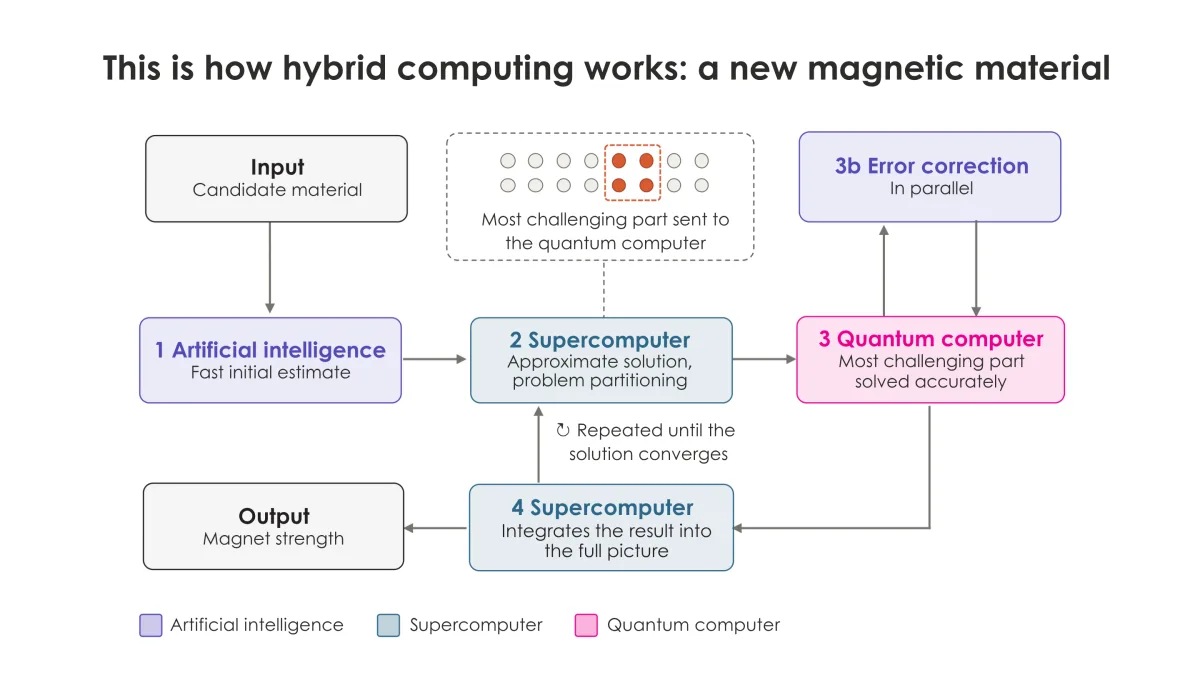
Consider calculating the magnetic strength of a wind turbine magnet, which stems from collective electron behaviour that conventional computers struggle to compute:
- AI rapidly approximates the material's electronic structure.
- A supercomputer refines this estimate using an approximate Schrödinger equation solution and identifies the calculation's most difficult component.
- A quantum computer calculates that difficult component with greater precision. Simultaneously, AI detects quantum computer errors for correction.
- The supercomputer incorporates the result into the full material model. Steps 2–4 repeat until convergence.
Finland at the forefront of hybrid computing
Within the FiQCI national quantum infrastructure framework, VTT's Helmi quantum computer connected to LUMI in 2022, positioning Finland among the world's earliest nations to merge quantum and supercomputing resources. Subsequently, LUMI gained connections to VTT's Q50, Aalto University's Q20, and the pan-European VLQ system based in the Czech Republic.
Expansion continues. The 150-qubit Q150 quantum computer, manufactured by IQM, has recently arrived at VTT's Otaniemi location. Present quantum systems remain too error-prone to outperform conventional machines on practical tasks. This makes LUMI-IQ the next critical milestone—scheduled for deployment at CSC's Kajaani data centre as part of the LUMI AI Factory programme. LUMI-IQ will incorporate more fault-tolerant qubits while serving as a cornerstone of the European Union's largest AI Factory.
Finnish researchers and organisations now access a cutting-edge computing infrastructure enabling exploration and preparation for what lies ahead. A future where supercomputing, artificial intelligence, and quantum computing collaborate to address problems ranging from fundamental physics to wind turbine magnets and smartphone batteries.