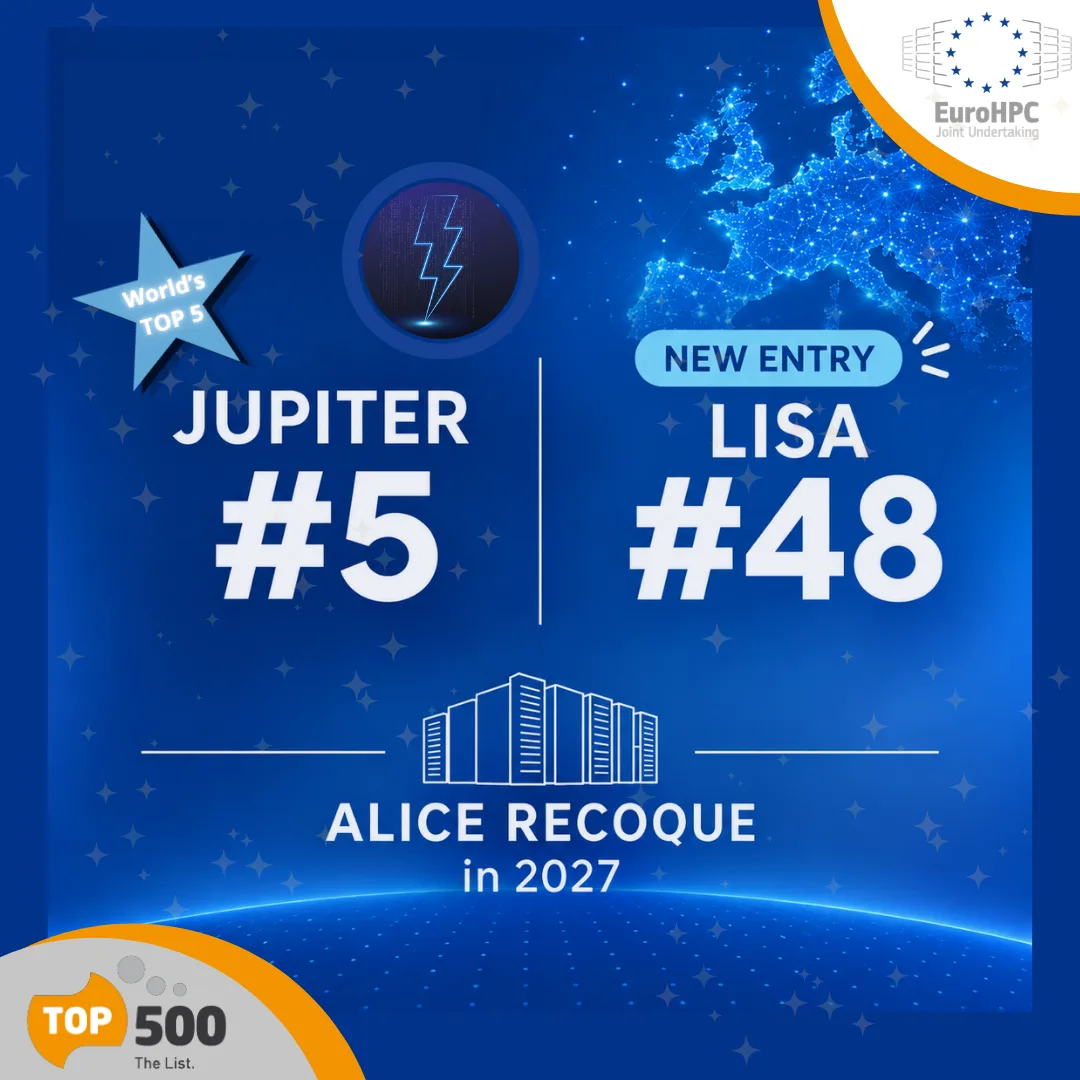
Europe's high-performance computing infrastructure demonstrated its competitive standing at the Supercomputing Conference in Chicago, where the November 2026 edition of the TOP500 and Green500 rankings were unveiled. The results underscore the continent's progress in supercomputing while signalling the imminent arrival of Alice Recoque, which will become Europe's second exascale system when it launches in 2027.
EuroHPC systems hold their ground in global competition
The 68th iteration of both rankings confirms that EuroHPC's operational supercomputers continue to occupy prominent positions worldwide. Every EuroHPC system currently in operation appears on the TOP500 list, with multiple installations ranking among the planet's most capable computing platforms. Energy efficiency remains a priority across the portfolio, with several machines also earning recognition on the Green500 index.
JUPITER maintains its position as the strongest-performing EuroHPC machine, claiming 5th place in the TOP500 and cementing its status among the world's top ten systems.
LISA (Leonardo Improved Supercomputing Architecture) made its debut on the TOP500 ranking at position 48, delivering 56.88 petaflops of performance. Managed by CINECA in Bologna, Italy, LISA represents the first EuroHPC computing partition purpose-built for artificial intelligence applications. The system incorporates 1,328 GPUs optimised for AI tasks, substantially expanding the AI processing capacity available through Leonardo.
Alice Recoque: preparing Europe's next exascale milestone
EuroHPC JU is advancing preparations for its next-generation infrastructure, designed to integrate high-performance computing, artificial intelligence and quantum capabilities into a unified platform.
France's TGCC supercomputing centre has completed its readiness work to accommodate Alice Recoque. The installation will proceed in phases, with initial computing racks expected to arrive at the facility during 2027.
EuroHPC JU finalised its contract with Bull in November 2025. The Jules Verne consortium, coordinating the project, brings together GENCI as the hosting entity, CEA as the hosting site, and European partners SURF from the Netherlands and GRNET from Greece. The group is managing preparations to ensure the system serves Europe's research and scientific communities effectively.
Complementing its supercomputing expansion, EuroHPC JU is simultaneously building out a continental network of AI Factories and AI Factory Antennas to broaden computing access.
Expanding the European computing ecosystem
An amendment to the EuroHPC Regulation took effect in January 2026, enlarging EuroHPC JU's remit to encompass AI Gigafactories and quantum technology advancement. This expanded scope triggered a wave of new commitments and funding decisions.
Six contracts were awarded for AI-optimised supercomputers across the continent:
- MareNostrum 5 AI upgrade in Spain
- HammerHAI in Germany
- Sweden AI Factory
- IT4LIA AI in Italy
- MeluXina-AI in Luxembourg
- LUMI-AI in Finland
EuroHPC JU launched a tender process in July to establish AI Gigafactories, signalling the scale of investment in artificial intelligence infrastructure.
To strengthen coordination and access across Europe's computing landscape, EuroHPC JU released the first version of the EuroHPC Federation Platform, offering researchers, businesses and public organisations a unified gateway to EuroHPC systems. A parallel initiative to deepen cooperation among AI Factories and AI Factory Antennas is expected to become operational in 2027.
The Barcelona Supercomputing Center is leading the EuroTPC project to advance artificial intelligence applications in scientific research. The EUMaster4HPC programme, covering 2026–2032, continues building advanced HPC expertise across member states.
Quantum computing development accelerated with four calls for quantum technologies, followed by six additional calls addressing quantum computing, communications, testing infrastructure and pilot production lines. EuroHPC JU opened pilot access to its quantum computers, initially including Euro-Q-Exa, Piast-Q, VLQ, Lucy and Ruby.
Two mid-range supercomputers were inaugurated: Arrhenius in Sweden, operated by NAISS, and DAEDALUS in Greece, operated by GRNET.
Canada joined as the 39th participating state in EuroHPC JU during the EU–Canada Summit held in Montréal in October, broadening the initiative's international footprint.
About EuroHPC JU
EuroHPC JU functions as a legal and funding mechanism uniting the European Union with participating countries to coordinate supercomputing efforts and pool resources, positioning Europe as a global supercomputing leader.
Following the adoption of Council Regulation (EU) 2026/150, EuroHPC JU's mandate expanded to include AI Gigafactory deployment and quantum technology advancement.
The initiative has procured 12 supercomputers distributed across Europe and oversees 19 AI Factories supplemented by 13 AI Factory Antennas providing free, tailored assistance to small and medium enterprises and startups. An additional 19 AI Factories are under procurement.
EuroHPC JU is deploying a European Quantum Computing infrastructure that integrates diverse quantum technologies with existing supercomputing resources. Alice Recoque will be inaugurated in France in 2027.
The organisation funds research and innovation initiatives to construct a complete European supercomputing value chain spanning processors, software, applications and expertise development.
European scientists and public and industrial users can access this HPC, AI and quantum infrastructure through EuroHPC Access Calls, regardless of location, to advance research and develop applications with industrial, scientific and societal value for Europe.