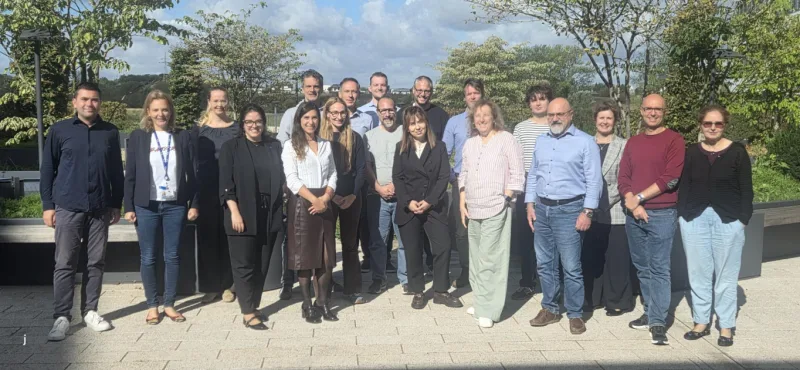
The European Union and Latin America have launched a collaborative framework to expand access to supercomputing infrastructure and AI capabilities across the region. Unveiled at the CARLA conference in Córdoba, Argentina on 22 September 2026, the EU–LAC Supercomputing Network for AI aims to overcome fragmentation in computing resources, uneven distribution of technological access, and workforce shortages while deepening integration between the two regions' research ecosystems.
The two-year initiative, which began in August 2026, encompasses seven Latin American nations: Argentina, Brazil, Chile, Colombia, Costa Rica, Mexico and Uruguay. Seven leading European research institutions form the backbone of the consortium, with the Barcelona Supercomputing Center (Spain) serving as coordinator alongside the Institute for Systems and Computer Engineering, Technology and Science (Portugal), Jülich Supercomputing Centre (Germany), CSC-IT Center for Science (Finland), the Institute of Information Science (Slovenia), the National Institute for Research in Digital Science and Technology (France), and CINECA (Italy).
The network aligns with the EU's AI continent action plan and the Global Gateway Strategy, receiving financial backing from the European Union alongside commitments from Spain and Brazil. It is designed to expand membership over time to encompass additional countries within the EU–LAC Digital Alliance framework.
The EU–LAC Supercomputing Network for AI brings Europe and Latin America closer together through high-performance computing and I am confident that European expertise, infrastructure and experience will positively help in accelerating innovation and tackling shared challenges across both regions.
Anders Dam Jensen, Executive Director of the EuroHPC JU
The responsible development of supercomputing and artificial intelligence can help tackle the everyday challenges faced by people across Latin America and the Caribbean, from natural hazards to health and energy. Through Global Gateway, we are bringing together our expertise to develop solutions that will help us achieve these objectives
Jozef Síkela, European Commissioner for International Partnerships
Key Objectives and Activities
The initiative will pursue digital transformation across Latin America and the Caribbean through partnerships that enhance technical compatibility with Europe's HPC infrastructure. Its core activities include:
- Policy Dialogues: Convening national and regional discussions to facilitate federation of HPC resources in the region and their eventual connection with European systems.
- Capacity Building: Developing expertise in HPC, AI, and Machine Learning through training initiatives, workshops, and an annual EU-LAC Summer School on HPC and AI, with emphasis on broadening participation among women and underrepresented communities.
- Joint Use Cases: Creating four collaborative projects demonstrating practical applications of HPC and AI cooperation in climate modelling, energy efficiency, natural hazard prediction, health, and large language models (LLMs).
- BELLA Integration: Leveraging the BELLA high-speed connectivity infrastructure—a 6,000 km submarine cable linking Europe and Latin America's research and education networks—to enable secure data exchange and support future federation of regional HPC resources.
About the EuroHPC Joint Undertaking
The EuroHPC Joint Undertaking represents a pooled effort by the European Union and member countries to establish European leadership in supercomputing globally. The initiative has already installed 12 advanced supercomputers across Europe, including JUPITER in Germany and Alice Recoque in France—Europe's first exascale systems. European researchers, businesses and public institutions can access these machines through EuroHPC Access Calls to support scientific discovery and commercially relevant applications.
The EuroHPC JU oversees deployment of 19 AI factories across Europe, supplemented by 13 AI Factory Antennas, delivering free specialized assistance to small and medium enterprises and startups. The organization is also constructing Europe's quantum computing infrastructure by integrating quantum technologies with its supercomputers, while funding development across the entire supercomputing supply chain—from chip design and software to applications and workforce development.
Following adoption of Council Regulation (EU) 2026/150, the EuroHPC JU's scope has broadened to encompass deployment of AI Gigafactories throughout Europe and advancement of quantum technologies. The JU recently opened a tender process for the Gigafactories initiative.
About the EU-LAC Digital Alliance
The EU-LAC Digital Alliance constitutes a two-region partnership promoting digital innovation and transformation between Europe and Latin America and the Caribbean under the EU's Global Gateway Strategy. The alliance operates through five strategic areas: political and regulatory cooperation, connectivity infrastructure, private sector participation, satellite data and space services, and additional programmes designed to enhance competitiveness and economic development, including the EU-LAC Supercomputing Network for AI.
Global Gateway functions as the EU's comprehensive approach to narrowing global investment gaps and fostering intelligent, sustainable and secure development in digital, energy and transport infrastructure, while reinforcing health, education and research capabilities.