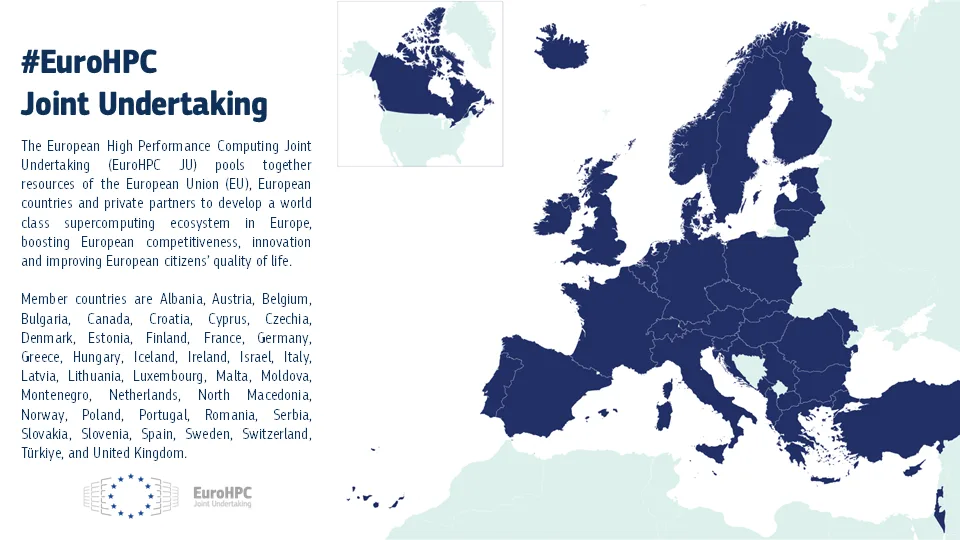
Canada's entry into the EuroHPC Joint Undertaking marks another milestone in assembling a coalition of nations committed to bolstering Europe's high-performance computing infrastructure, advancing scientific discovery and unlocking innovation across the business sector. The timing reflects broader efforts by the European Union and Canada to forge closer ties through enhanced trade arrangements, aligned principles and complementary technological capabilities.
Research and innovation collaboration between the EU and Canada stretches back to 1996, when both parties signed the Agreement for Scientific and Technological Cooperation. Since 2024, Canada has participated in the Horizon Europe research programme.
Through its membership in EuroHPC JU—a European funding body established under EU legislation—Canada joins a mechanism that consolidates European and national funding to acquire supercomputing infrastructure and finance research into supercomputing systems, applications and workforce development. Alongside other Participating States, Canada gains entry to the Joint Undertaking's portfolio of HPC, AI and Quantum computing resources. Canadian researchers will now partner with European colleagues on frontier projects spanning artificial intelligence, high-performance computing and quantum technologies. The arrangement supports Europe's objective of achieving technological independence in these domains and fostering a premier supercomputing ecosystem across the continent.
Evan Solomon, Canada's Minister of Artificial Intelligence and Digital Innovation and Minister responsible for the Federal Economic Development Agency for Southern Ontario, commented:
Advanced computing power is critical to turning ambitious ideas into scientific breakthroughs and economic opportunities. Joining EuroHPC JU will deepen Canada's partnership with Europe and open new opportunities for Canadian researchers and innovators to access world-class supercomputing, AI and quantum computing resources. This collaboration will help advance cutting-edge research, strengthen our collective technological capabilities and ensure Canada and Europe remain at the forefront of emerging technologies.
Evan Solomon, Canada's Minister of Artificial Intelligence and Digital Innovation
Roberto Viola, Director-General of the European Commission's Directorate-General for Communications Networks, Content and Technology, stated:
I am proud to see EuroHPC membership extended to Canada, opening up new opportunities for researchers, businesses and government. EuroHPC membership will advance common work on some of the key areas of our time: supercomputing, AI infrastructure and quantum computing. The excellent cooperation with Canada, reflected in the EU-Canada Digital Partnership, continues to build secure and world-class digital capabilities together.
Roberto Viola, Director-General, DG CNECT, European Commission
Anders Jensen, Executive Director of EuroHPC JU, added:
Canada's adhesion to the EuroHPC Joint Undertaking reflects the growing importance of international partnerships in developing a sovereign European world-class supercomputing ecosystem. By joining forces, Europe and Canada will reinforce their technological strengths and advance scientific excellence and innovation. We warmly welcome Canada to our community and look forward to working together to further strengthen our collective capabilities and ambitions.
Anders Jensen, EuroHPC JU Executive Director
Background
The EuroHPC JU functions as both a legal entity and funding mechanism, uniting the European Union with participating nations to coordinate action and combine resources with the aim of positioning Europe as a global supercomputing leader.
The Joint Undertaking's Governing Board comprises officials from the European Commission's DG CNECT and representatives from 39 Participating States.
To establish cutting-edge supercomputing capacity across the continent, EuroHPC JU has already acquired 12 supercomputers positioned throughout Europe. The organisation is simultaneously managing deployment of 19 AI Factories across the region, supported by 13 AI Factory Antennas that deliver tailored assistance at no cost to small and medium enterprises and startup companies. In parallel, EuroHPC JU is rolling out a European Quantum Computing infrastructure that combines various European quantum technologies with operational supercomputers.
European researchers and organisations from government and the private sector can leverage the continent's HPC, AI and Quantum computing infrastructure through EuroHPC Access Calls, which operate irrespective of geographic location within Europe, to accelerate scientific progress and facilitate development of applications with industrial, scientific and societal value for the region.
The EuroHPC JU also finances research and innovation initiatives aimed at constructing a comprehensive European supercomputing value chain, encompassing processors, software, applications designed for these systems and expertise to nurture robust European HPC capabilities.
Following the recent enactment of Council Regulation (EU) 2026/150, EuroHPC JU's scope has been broadened to include fresh strategic priorities focused on establishing AI Gigafactories throughout Europe and accelerating quantum technology advancement.