Rivalry between operators and satellite firms unlikely to transform European telecoms
Vodafone Group announced it has "made the world's first space video call using normal 4G/5G smartphones and satellites," leveraging an AST SpaceMobile low-Earth orbit (LEO) satellite for the transmission.
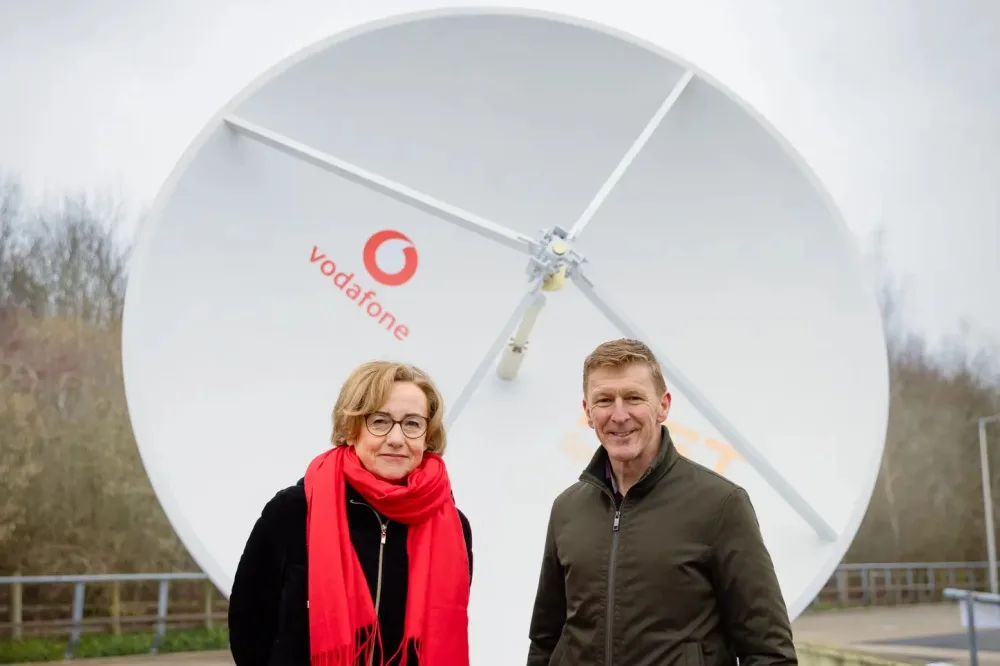
Engineer Rowan Chesmer at Vodafone initiated the call from a remote area in mid-Wales lacking terrestrial mobile coverage. The connection travelled through an AST Bluebird satellite before reaching Earth via a space-to-land gateway connected to Vodafone's network infrastructure. The call then reached Vodafone Group CEO Margherita Della Valle on a standard Pixel smartphone, with British astronaut Tim Peake present during the demonstration.
Vodafone holds a 4.6% stake in SpaceMobile valued at approximately €285 million as of November. The operator has committed $60 million (€57.6 million) across three investment rounds beginning in 2018. A definitive commercial partnership between the two companies, signed in December 2024, extends through the end of 2034.
Della Valle stated, "Vodafone's job is to get everyone connected, no matter where they are. Our advanced European 5G network will now be complemented with cutting-edge satellite technology. We are bringing customers the best network and connecting people who have never had access to mobile communications before. This will help to close the digital divide, supporting people from all corners of Europe to keep in touch with family and friends, or work, as well as ensuring reliable rural connectivity in an emergency."
Kester Mann, Director of Consumer and Connectivity at CCS Insight, offered perspective on the European opportunity: "Although exciting, the opportunity for satellite services in Europe is less clear-cut than in other regions. This is main due to the already strong mobile and fibre coverage, meaning that the technology will likely only ever fulfil a complementary role for operators. Places like Africa, Australia, and India offer greater potential, either in connecting people for the first time or for people travelling through or into their vast areas that lack terrestrial coverage."
Mann acknowledged the broader significance of the achievement, noting, "This is a significant milestone for the burgeoning and increasingly competitive satellite communications sector which has so far mostly focused on person-to-person and emergency messaging. Using 'normal' smartphones has a clear advantage in that there is a large existing market for operators like Vodafone to go after. CCS Insight's research shows that there are more than 1 billion smartphones in use in the region that could already work with the technology."
Vodafone intends to launch "the first commercial direct-to-smartphone broadband satellite service in Europe from later in 2025 and 2026." According to Mann, "Offering a commercial service as soon as later this year is ahead of many people's expectations. However, no details have been shared about pricing, which will be the main driver of take-up. Encouragingly, recent research from CCS Insight shows that almost half of UK consumers could be willing to pay to make and receive voice calls or access the Internet over satellite."