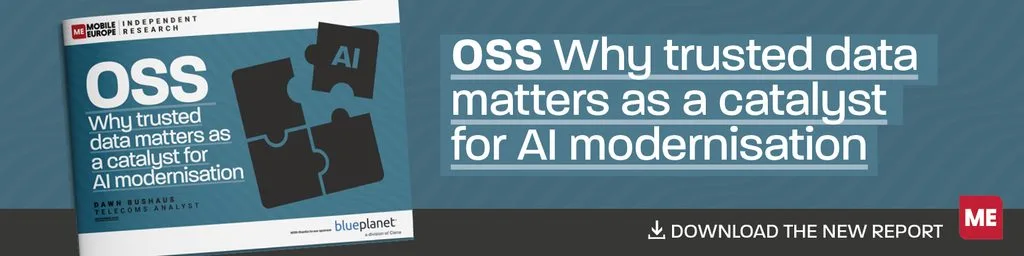
Network operators across Europe are grappling with a fundamental challenge: their organisations sit on vast troves of operational data, yet much of it remains siloed across incompatible legacy systems. As artificial intelligence becomes increasingly central to how telecoms firms manage their infrastructure, this fragmentation is becoming a critical bottleneck. Mobile Europe's latest independent research, titled OSS: Why trusted data matters as a catalyst for AI modernisation and authored by telecoms analyst Dawn Bushaus with sponsorship from Blue Planet, investigates why overhauling operational support systems (OSS) has become essential for AI deployment.
The research draws on perspectives from AT&T, Orange Business, Telefónica Deutschland and other industry voices to map the obstacles carriers encounter as they pursue AI-native network architectures and the strategies they are employing to overcome them.
Key themes in the research
The report examines several interconnected challenges facing operators navigating this transition:
- The necessity of retiring or reimagining aging OSS infrastructure
- Strategies for raising data quality and dismantling organisational data silos
- The requirement that AI systems comprehend network data semantically, rather than merely accessing it
- The role of governance frameworks and human decision-making in ensuring safe AI operations
- Concrete modernisation efforts underway at AT&T, Orange Business and Telefónica Deutschland
The analysis also considers emerging technical approaches—including knowledge graphs, orchestration platforms and event-driven architectures—that enable carriers to construct progressively more intelligent and self-managing networks.
As AI becomes more deeply embedded in telecoms operations, the availability of trustworthy, interconnected data infrastructure will prove decisive for competitive advantage.