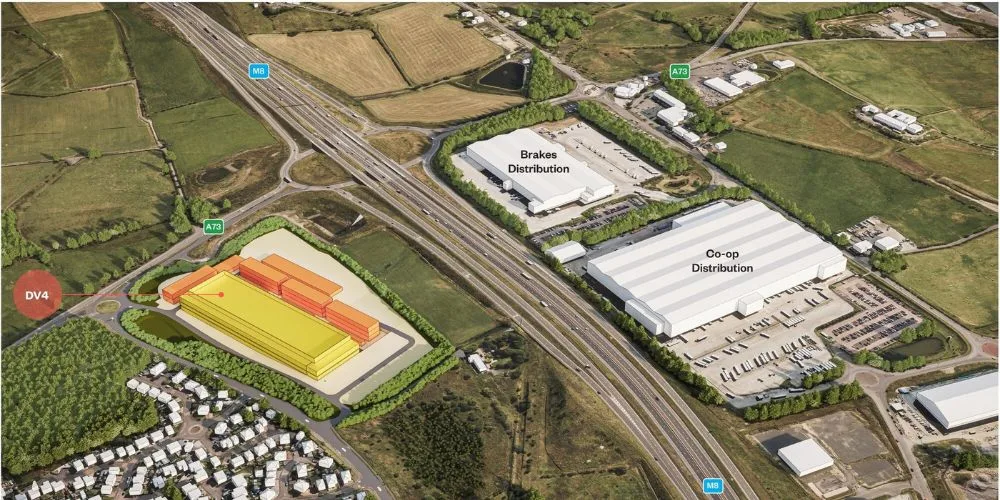
DataVita, a Scottish operator of data centres and cloud services, has filed a planning application for a substantial new facility at its existing Chapelhall site in North Lanarkshire. The DV4 project carries a construction price tag of £849.6 million ($1.1 billion) spread across two years and sits within the Lanarkshire AI Growth Zone, which the UK Government designated in January 2026 as Scotland's inaugural AI Growth Zone.
The company projects that construction would generate 2,650 job-years of employment and create 120 permanent positions at the operational facility, alongside apprenticeship opportunities. DataVita expects local suppliers to deliver at least 40% of capital contracts.
Extending an established campus
DV4 represents the continuation of DataVita's presence at Chapelhall, where the company has maintained operations for more than a decade. The operator currently runs DV1 at the location, which it describes as Scotland's largest purpose-built Tier III certified data centre. Construction of DV3 is underway on the adjacent site, and DataVita also manages a separate facility in Glasgow.
Danny Quinn, Managing Director of DataVita, distinguished the company's track record from other proposals emerging across Scotland. "We have seen a lot of data centre speculation in Scotland recently, and the vast majority of it will never be built," Quinn stated. He continued: "DataVita has been operating in Scotland for more than ten years, and we already underpin a lot of the critical services used day in, day out across Scotland. We built DV1 at Chapelhall, we are building DV3, and we run them ourselves with a Scottish team. DV4 is the next stage of that campus."
Design refinements following public engagement
DataVita conducted four public consultation events before submitting its application, exceeding the required number by two. The company made consultation materials available online and published responses to frequently asked questions, stating that community input shaped the final design.
Notable modifications include a reduction in the proposed building height from 30 metres to 26 metres. The operational plant equipment has been relocated to the south side of the structure, away from residential areas. The plans also incorporate 1,000 metres of native hedgerow planting.
Quinn urged residents to review the detailed plans as North Lanarkshire Council processes the application. "The application is now with the council and open for comment, and I would encourage people to look at the detail," he said.
Energy and water efficiency targets
DV4 has been engineered to meet specific environmental performance benchmarks. The facility will operate entirely on renewable electricity sourced from certified Scottish generation, with a target power usage effectiveness (PUE) of below 1.25.
Cooling will rely on a sealed, closed-loop system without evaporative cooling technology. Water consumption is targeted at 0.05 litres per kilowatt-hour or lower. Heat recovery systems are integrated into the design from the outset, and DataVita is in discussions with the Monklands Replacement Hospital and the neighbouring BioCity campus regarding potential reuse of waste heat from the facility.
Community investment and economic contribution
Beyond construction spending, DataVita estimates DV4 would generate over £30 million ($40.5 million) in business rates for North Lanarkshire Council across 25 years. The company plans to establish a DV4 Community Investment Fund, committing £75 million ($101.3 million) over 15 years. An independent board will oversee the fund, directing resources toward projects initiated and managed by the local community.
The economic case thus extends beyond the 120 permanent operational roles. DataVita has linked the application to apprenticeships, local procurement commitments and sustained community investment.
Wider growth zone context
The Lanarkshire AI Growth Zone, designated by the UK Government in January, is projected to attract £8.2 billion ($11 billion) in private investment, generate more than 3,400 jobs and establish a community fund valued at up to £543 million ($733.8 million), according to DataVita.
Scotland's AI Strategy 2026–2031, released by the Scottish Government in March, includes commitments to position the country as a location for green data centres and to unlock the economic potential of the Lanarkshire AI Growth Zone.
The DV4 application follows DataVita's announcement last month of £300 million ($405.3 million) in funding for the first phase of its North Lanarkshire AI data centre expansion, which will finance additional AI infrastructure development in the region.
Quinn expressed DataVita's ambition to reshape perceptions of data centre development in Scotland. "Not all data centres are the same, and we are keen to change the public perception," he said. "Scotland has an opportunity not only to become a data centre location but an exporter of intelligence via low-carbon data centres."
With DV1 already operational and DV3 under construction at Chapelhall, DV4 would build upon an existing DataVita campus rather than establish a new site. The planning application is now open for public comment at North Lanarkshire Council.