Danielle A. Davis Canty, Esq., serves as director of technology policy at the Joint Center for Political and Economic Studies, produces The Miseducation of Technology Podcast, and holds a Public Voices Fellowship on Technology in the Public Interest through The OpEd Project.
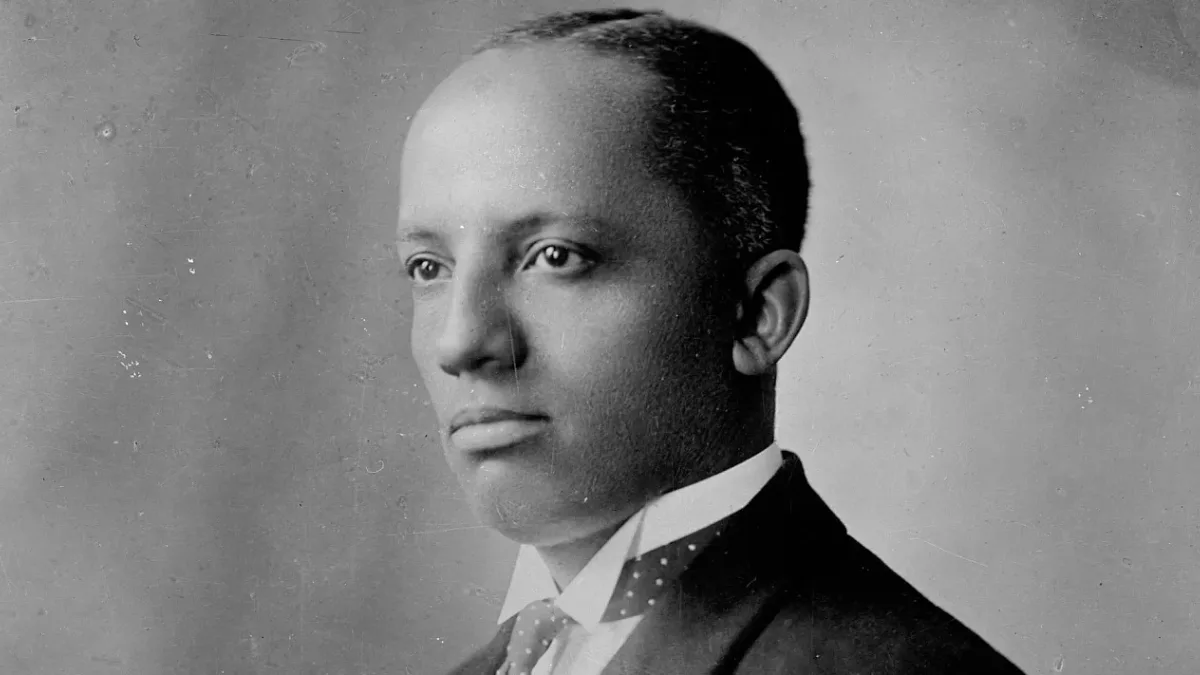
The existence of Black History Month in America traces back to Carter G. Woodson, a historian and writer who recognized that African Americans required agency in shaping their own education—determining curriculum content and establishing whose perspectives carried intellectual weight.
In 1926, Woodson launched Negro History Week, which would eventually evolve into Black History Month. His initiative addressed a systemic problem: educational materials rendered Black and African contributions invisible, depicted Black people as subordinate, and positioned European and white perspectives as the universal norm. This was not a single falsehood but rather an institutional apparatus that systematized which knowledge mattered, which was suppressed, and what learners internalized as ordinary.
Woodson's book The Mis-Education of the Negro, particularly its third chapter titled "How We Drifted Away from the Truth," illustrates how miseducation operates through institutional repetition and authority. Geography, science, language, literature, law, medicine, and history all followed the same pattern: systematic erasure or denigration of Black achievement. This conditioning normalized racial hierarchy among students of all backgrounds, framing it as natural rather than as a consequence of deliberate pedagogical decisions.
Engaging with Woodson's analysis prompted a question that remains pressing: who shapes our understanding of the world, and who gains from those particular framings? As a Black woman engaged in technology policy, this inquiry pushed me to examine what we are conditioned to believe about technology itself. That investigation ultimately became the foundation for my podcast, The Miseducation of Technology.
The educational pattern Woodson identified reappears in contemporary technology discourse.
Digital systems are presented as impartial. Algorithms are characterized as unbiased. Data is treated as truthful. When systems produce harmful outcomes, explanations typically emphasize technical factors: programming errors, scalability challenges, or unanticipated side effects.
This replicates Woodson's framework. Miseducation does not depend on explicit manipulation. Educators and institutions may operate in good faith, yet the selective presentation of material and strategic omissions condition people to accept dominant narratives even when results are inequitable. The outcome is not lack of knowledge but learned deference: individuals absorb which inquiries are permissible and which fall beyond acceptable discourse.
Identical mechanisms govern technology conversation today. Media and policy focus concentrates on metrics like speed, efficiency, and innovation, while questions regarding design philosophy, power structures, and responsibility receive marginal attention. Technology appears as a neutral instrument, and disparate outcomes become technical malfunctions or inevitable complexities rather than manifestations of human judgment. Accountability evaporates into the refrain: "That's just how the system works."
This captures what I identify as the miseducation of technology.
The issue is not that people remain blind to damage. Rather, they are conditioned to understand damage as unintentional or unavoidable, obscuring the actual sources: decisions about who builds these systems, which populations' needs are prioritized, and which actors direct implementation. Just as Woodson demonstrated how pedagogy naturalized racial hierarchy by presenting it as inevitable, contemporary technology narratives normalize inequality by characterizing it as neutral and inescapable.
For Black communities, these consequences manifest in tangible ways. Facial recognition surveillance has been concentrated in Black neighborhoods and exhibits higher error rates for Black individuals, resulting in unjust detentions and arrests. Algorithmic systems governing employment, lending, and medical care perpetuate historical discrimination while claiming objectivity and empirical grounding. Infrastructure choices—including disparate broadband access and placement of energy-intensive data facilities—transfer expenses, dangers, and ecological damage to populations with minimal voice in decision-making.
These patterns are frequently characterized as unplanned or unforeseeable. Yet Woodson established that when systems are constructed and controlled without input from those bearing their consequences, disparity is not accidental—it is inevitable. In this framework, technological disparity is not shocking. It is foreseeable.
Returning to Woodson during Black History Month underscores that he rejected the miseducation of Black Americans as unchangeable. He identified it, contested it, and asserted that transformation was achievable.
Woodson could not have foreseen machine learning, algorithmic systems, or digital networks. Yet the mechanism he analyzed—the socialization of people to trust institutional authorities even when those authorities produce unequal results—remains strikingly current.
As Woodson resisted miseducation in his era, we need not accept it in the digital age.
This principle drives my podcast, The Miseducation of Technology—and explains why the project of interrogating technology remains incomplete.
Technology may be miseducated, but we need not be.
Source: Tech Policy Press