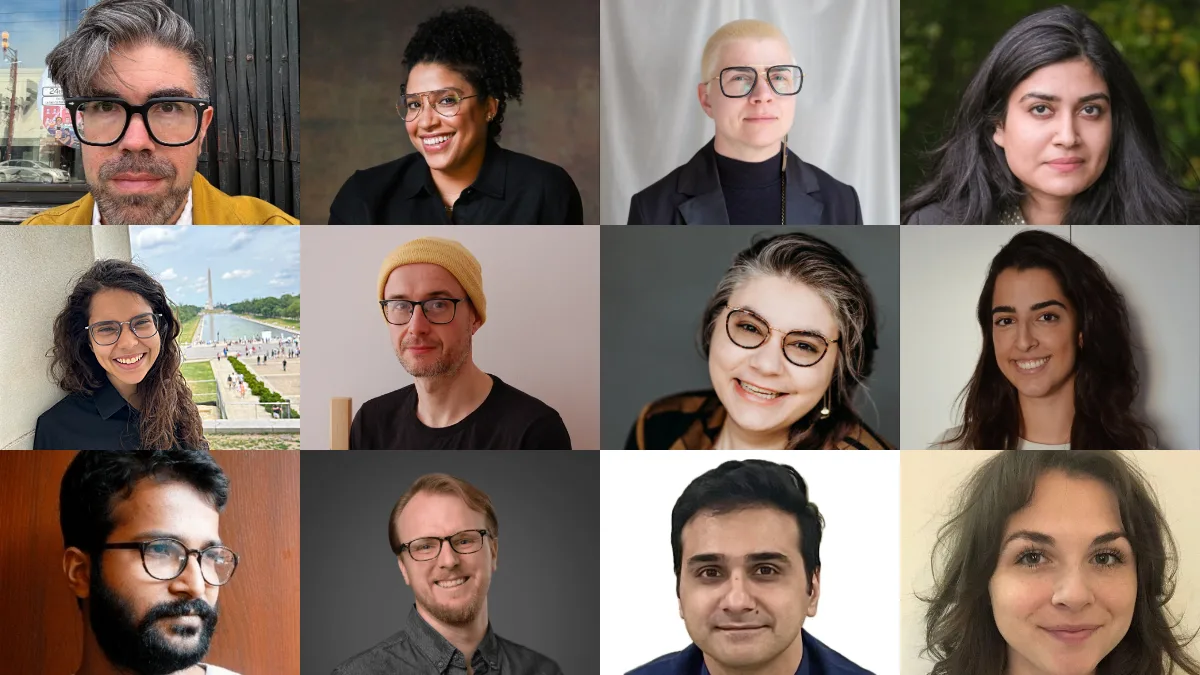
Tech Policy Press is broadening its editorial capacity and geographic reach by welcoming three new editors and announcing a second class of nine reporting fellows. The appointments reflect the outlet's commitment to diversifying voices and deepening coverage of technology policy across multiple disciplines and regions.
Ramsha Jahangir named Associate Editor
Ramsha Jahangir has joined Tech Policy Press as Associate Editor in a full-time role. She previously served as head of Policy and Communications at the Global Network Initiative, where she continues to work as a Senior Fellow on human rights and technology matters. An award-winning journalist and 2024 Tech Policy Press fellow, Jahangir has produced extensive reporting on platform governance, surveillance, and digital authoritarianism. She holds a Master's in Journalism, Media, and Globalization from the University of Amsterdam, where she received the Erasmus Mundus Journalism scholarship. Based between Amsterdam and Karachi, she brings experience across multiple continents.
Dean Jackson and Amber Sinha named Contributing Editors
Two alumni of the 2024 fellowship program, Dean Jackson and Amber Sinha, have been appointed as part-time Contributing Editors to the publication's masthead.
Jackson leads Public Circle Research and serves as a non-resident fellow at both the Digital Forensic Research Lab and American University's Center for Security, Innovation, and New Technology. He previously worked as an investigative analyst for the Select Committee to Investigate the January 6th Attack on the US Capitol. With a decade of think tank experience, Jackson holds an MA in international relations from the University of Chicago and a BA in political science from Wright State University in Dayton, Ohio. He is based outside Cleveland, Ohio.
Sinha works at the convergence of law, technology, and society, examining how digital technologies reshape socio-political processes. His research contributes to broader conversations on internet regulation and technology governance. Until 2022, he served as Executive Director of the Centre for Internet and Society, India, overseeing initiatives in privacy, digital identity, data governance, and artificial intelligence. The Supreme Court of India and multiple government committees have cited his research. Sinha participates on the GPA Reference Panel for the Global Privacy Assembly and serves as an expert member of ONE AI at the OECD. His 2019 book, The Networked Public, examined these themes. He is based in Delhi.
2025 Reporting Fellows named
Following review of nearly 700 applications, Tech Policy Press has selected its second cohort of reporting fellows. The group will pursue investigations aligned with their individual expertise and interests, with particular emphasis on artificial intelligence and emerging technology policy questions.
Anika Collier Navaroli
Collier Navaroli is an award-winning writer, lawyer, and researcher specializing in journalism, social media, artificial intelligence, trust and safety, and technology policy. She currently holds positions as Senior Fellow at the Tow Center for Digital Journalism at Columbia University and McGurn Senior Fellow for Media Integrity at the Consortium on Trust in Media and Technology at the University of Florida. Her decade-long career spans law firms, think tanks, advocacy organizations, and senior policy roles at Twitter and Twitch.
Ariana Aboulafia
Aboulafia directs the Disability Rights in Technology Policy project at the Center for Democracy & Technology, where she works to enhance technology benefits while reducing harms for people with disabilities. Her focus includes algorithmic bias and privacy concerns in employment, healthcare, and assistive technology contexts. An attorney with expertise in disability law, technology, criminal law, and the First Amendment, she began her technology work as a fellow at the Cyber Civil Rights Initiative. She later served as an assistant public defender in Miami-Dade County and as an officer in the Journalism program at the John S. and James L. Knight Foundation. Her writing has appeared in the University of Florida Journal of Law and Public Policy, the Connecticut Public Interest Law Journal, Slate, Tech Policy Press, and Teen Vogue.
Dia Kayyali
Kayyali (they/them) serves on the Core Committee of the Christchurch Call Advisory Network and works as a technology and human rights consultant and community organizer. As a prominent figure in content moderation and platform accountability, their work examines the real-world consequences of policy decisions by governments and technology firms, particularly for communities in global majority countries. Kayyali has organized international efforts to challenge and reform policies affecting vulnerable populations, including LGBTQIA+ people and religious minorities, and has directly engaged policymakers in the United States, European Union, and beyond. Previous roles include Senior Case and Policy Officer at the Oversight Board, Policy Director at Mnemonic, Tech + Advocacy Program Manager at WITNESS, and activist positions at the Electronic Frontier Foundation.
Eryk Salvaggio
Salvaggio combines skills in hacking, research, design, and media art to investigate technology's social and cultural dimensions, with particular attention to artificial intelligence. He serves as a 2025 visiting professor in the Humanities, Computing, and Design program at Rochester Institute of Technology and teaches Responsible AI at the Elisaba Barcelona School of Design and Engineering. Alongside research in AI, art, and education at MetaLab (at) Harvard University, he advises on emerging technology matters for the Siegel Family Endowment. He maintains a regular newsletter at cyberneticforests.com.
Jasmine Mithani
Mithani is a journalist committed to translating complex topics for broad audiences. Her varied career includes roles as visual journalist, game developer, civic tech software consultant, alt-weekly editor, and user experience designer. She has reported for outlets ranging from national to hyper-local publications, including FiveThirtyEight, National Public Radio, and South Side Weekly. Currently a tech and data reporter at The 19th, an independent nonprofit newsroom examining gender, politics, and policy, she frequently explores information access, technology-facilitated harms, and privacy. Her reporting regularly centers LGBTQ+ perspectives and intersects with reproductive rights. She contributed to The 19th's 2023 Online Journalism Award-winning coverage of the Dobbs decision, and her visualizations have received long- and short-list recognition from Information Is Beautiful Awards. Mithani speaks regularly on journalism best practices regarding mixed-race coverage, LGBTQ+ data work, and accessible data visualization. She also publishes the newsletter Data + Feelings.
Laís Martins
Martins is a Brazilian investigative journalist based in São Paulo whose reporting examines technology, human rights, and politics and their intersections. Her investigations have appeared in both Brazilian and international outlets, including The New York Times, The Guardian, and the Associated Press. She currently works as a reporter at The Intercept Brasil on technology investigations. Martins previously held a fellowship at the Pulitzer Center for work examining how Bolsonaro-era gun policies affected Brazilian women, and most recently at Rest of World, investigating labor and technology dynamics in Brazil and Latin America. She holds a bachelor's degree in Journalism and a master's degree in Political Communication from the University of Amsterdam and the University of Aarhus in Denmark.
Megan Kirkwood
Kirkwood is a researcher and writer focusing on competition and antitrust matters, particularly within digital markets and regulatory frameworks. Her research interests encompass technology regulation, digital platform studies, market concentration, ecosystem dependencies, and digital privacy, with emphasis on Europe and the UK. She has contributed substantially to Tech Policy Press, including detailed analysis of Europe's Digital Markets Act rollout and implications. Recent work involves monitoring implementation of this legislation, including an empirical study of gatekeeper compliance presented in Brussels. Kirkwood holds an MA in Digital Culture and Society from King's College London, where she studied the social, political, and economic dimensions of communication technologies and emerging innovations such as artificial intelligence. Following her studies, she worked as a research and advocacy assistant at The Civil Liberties Union for Europe. She is based in London.
Prateek Waghre
Waghre transitioned from technology work to public policy research in India. Most recently, he served as Executive Director and Policy Director at the Internet Freedom Foundation, a digital rights organization. Before that, he was a technology policy researcher at The Takshashila Institution. Waghre spent nearly a decade in content delivery networks and technology industries in product management and solutions engineering before shifting to policy research. He focuses on how technology deployment affects liberal democratic societies and spaces, with research interests spanning the information ecosystem, state control mechanisms, societal exploitation of digital openness, and the evolution of digital rights—including privacy, surveillance, and free expression—in liberal and authoritarian contexts.
William Burns
Burns brings nearly 20 years of science and technology policy experience at the intersection of health, environment, food, and sustainable energy. His background includes a PhD in malaria biochemistry and an MSc in science communication. More recently, he studied the history of science, technology, and medicine as a Hans Rausing Scholar at Imperial College, London. He spent close to a decade in a learned society and at the UK Energy Research Centre, where he helped advance knowledge and evidence uptake in Whitehall and Brussels, focusing on decarbonization, sustainability, pollution control, and public health. He is interested in the technology-society relationship and how it might be shaped constructively, as well as how history and path dependency influence current decision-making.
Tech Policy Press acknowledges the foundation funders and individual donors whose support enables this work.
Source: Tech Policy Press