Nicole Gill is co-founder and executive director of Accountable Tech.
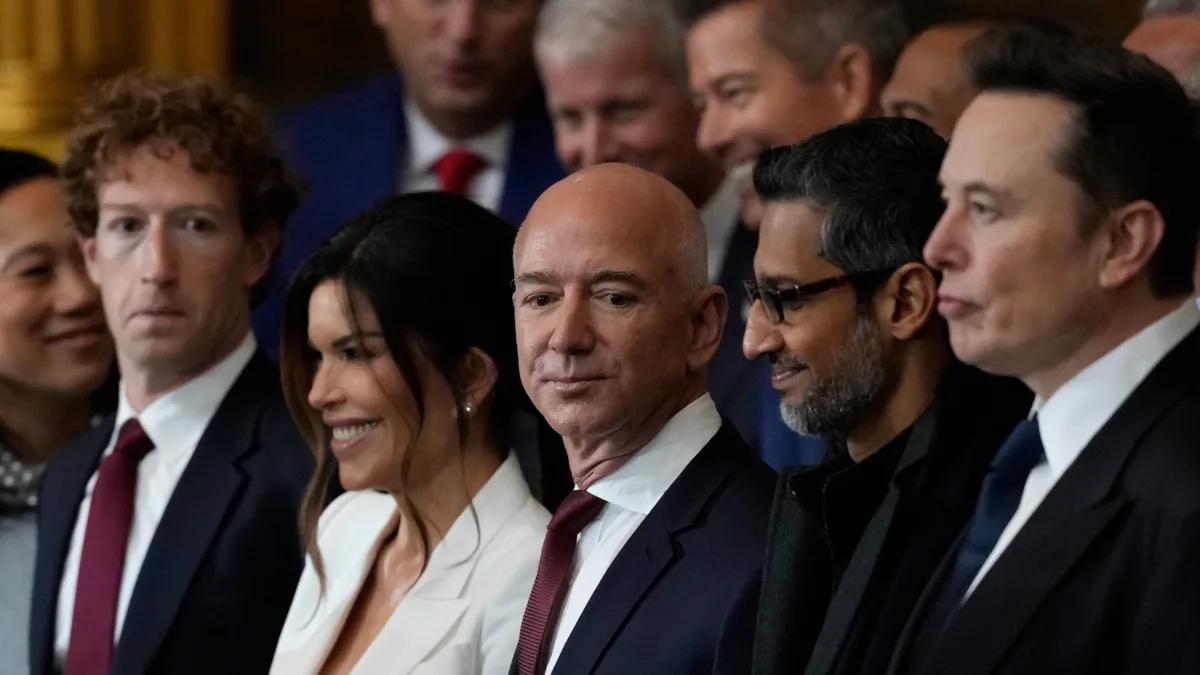
January 20 offered the world a striking demonstration of a partnership that has been developing for years: the now-undeniable collaboration between major technology firms and right-wing politics. Seated prominently at President Donald Trump's inauguration were figures including Meta's Mark Zuckerberg, Amazon's Jeff Bezos, and Google's Sundar Pichai. Their presence signaled more than symbolic support—through decisions to dismantle diversity initiatives, abandon fact-checking operations, and contribute millions to Trump's inaugural coffers, these executives have positioned themselves as integral to the incoming administration.
The alignment should not come as a shock. For years, civil society organizations have warned about technology companies' antagonism toward factual accuracy and democratic processes. Some elected officials heeded these warnings and attempted to establish safeguards—mechanisms designed to combat false information and prevent real-world consequences while maintaining the competitive conditions necessary for democracy to function. Others rejected this approach, contending that the tech sector's inherent commitment to openness and social responsibility made regulation unnecessary.
Tech industry advocates could point to genuine examples of pro-democracy positions. Technology executives have traditionally championed abortion access and LGBTQ protections. Following the January 6th insurrection, Zuckerberg himself moved to remove Trump from his platform.
Yet recent conduct by technology executives has exposed their true priorities: while maintaining superficial commitments to democratic values, major tech corporations have methodically consolidated control over communication channels and subordinated them to right-wing interests. Within the United States, the critical question becomes whether those opposing MAGA politics will acknowledge this partnership between extremism and Big Tech—and whether they will move to constrain this dangerous trajectory before democratic institutions collapse entirely.
Mutual Benefits of an Extremist Partnership
Both parties derive immediate advantages from this arrangement. Extremism functions as a cornerstone of the Big Tech profit model, which depends on user engagement to generate advertising income. Advertising provides Meta with more than 95% of its revenue, and relaxing guardrails against hateful content will inevitably produce greater outrage, participation, and advertising returns.
For MAGA-aligned Republicans, false information serves a purpose beyond mere accident—it constitutes their strategy. During 2024, voters whose understanding of reality had been distorted by misinformation reflecting far-right narratives—such as claims that inflation was rising (it was not) or that southern border crossings had reached record levels (they had not)—voted decisively for Trump over former Vice President Kamala Harris. Baseless theories circulated widely, ranging from allegations that Harris obstructed hurricane relief efforts to claims about Haitian migrants. Research from Navigator Research indicated that the majority of voters who supported Trump in 2024 identified social media as their primary news outlet.
This represents merely one chapter in a longer narrative. The Republican Party has repeatedly partnered with industries—fossil fuels, firearms manufacturers—in exchange for financial backing. However, this particular alliance carries heightened danger because it does not concern a single policy matter. Rather, it encompasses every issue: from environmental policy to gun regulations to healthcare, the spread of MAGA ideology through America's information channels jeopardizes advancement on virtually all fronts.
The partnership grants right-wing actors something beyond amplification. Technology corporations maintain detailed records of our political leanings, social networks, purchasing patterns, media consumption, and physical movements. Such information constitutes a formidable instrument—especially when directed toward authoritarian objectives.
Technology firms' databases are currently being weaponized to prosecute individuals seeking abortion and to identify, apprehend, and expel migrants. What prevents Trump from deploying these same resources to monitor critical journalists, eliminate political rivals, or track women pursuing abortion care? Should we genuinely trust the now-submissive technology executives to defend our information if the Trump administration demands access?
Democracy Requires Immediate Action
Acknowledging the MAGA-Big Tech partnership transcends Democratic electoral interests. It concerns the viability of any organized opposition to MAGA—and the survival of democratic governance itself. The 2024 election demonstrated that candidates' policy proposals and track records become irrelevant if voters cannot receive and accept those messages. Without swift regulatory intervention by Democrats and allied forces, candidates will continue promoting sound policies and genuine achievements, only to face defeat against pervasive misinformation and algorithmic suppression.
When a single faction possesses structural mechanisms enabling repeated electoral victories regardless of candidate quality or circumstances, the system ceases to be democratic. It becomes authoritarian rule.
Opportunity remains to reverse course. However, overcoming the MAGA-Big Tech partnership demands that Democrats, particularly, abandon their accommodating stance toward Silicon Valley and establish tech regulation as a foundational party commitment. In states where Democrats control both legislative chambers and the governorship—fifteen in total—officials should immediately construct barriers between state government and technology corporations. Such measures would both expose the dangers of a MAGA-controlled surveillance apparatus and shield personal information from exploitation in abortion prosecutions or mass deportation campaigns.
At the national level, Democrats cannot continue supporting candidates or officials whose tech industry donors push them to obstruct accountability measures or prevent legislation from advancing through Congress.
The inauguration festivities of the previous week provided the most visible demonstration of technology billionaires' alignment with Trump, though additional evidence will undoubtedly emerge. The fusion of MAGA and Big Tech represents an existential danger to democratic systems—a threat that will intensify. Those who reject far-right ideology must mobilize immediately to resist, or accept permanent defeat.
Source: Tech Policy Press