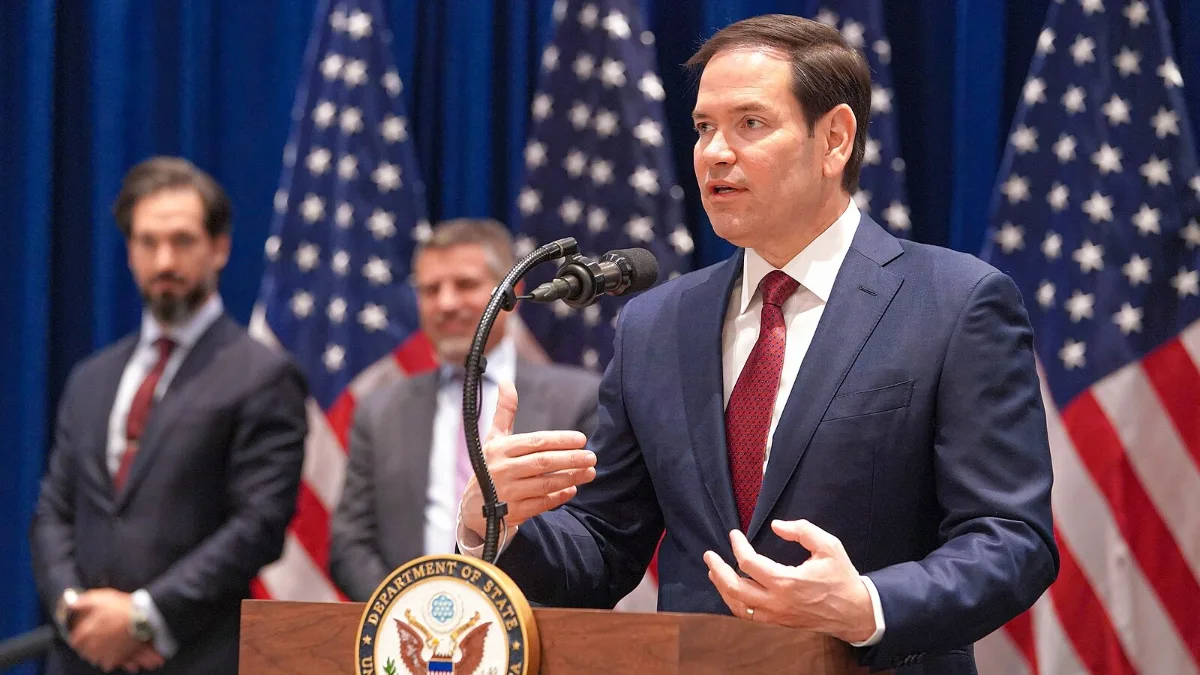
On Wednesday, Secretary of State Marco Rubio unveiled a Visa Restriction Policy Targeting Foreign Nationals Who Censor Americans. Drawing on his authority to bar entry by those whose presence would carry potentially serious adverse foreign policy consequences for the United States, Rubio declared he will block visits from foreign officials who demand that American tech platforms adopt global content moderation policies or engage in censorship activity that reaches beyond their authority and into the United States. In a post on X, he stated: Whether in Latin America, Europe, or elsewhere, the days of passive treatment for those who work to undermine the rights of Americans are over.
The policy's scope is expansive yet imprecise enough to encompass numerous ways foreign officials, operating within their own legal systems, shape content moderation on social platforms—even when addressing legitimate harms like hate speech, election interference, disinformation, or incitement to violence. The move appears rooted in grievances long nursed by Trump and his political allies.
Rubio's reference to Latin America points toward Brazil, where a supreme court justice drew fire for ordering X to take down posts by right-wing extremists following a 2023 coup attempt. The clash between Justice Alexandre de Moraes and X owner Elon Musk led to the platform's suspension in Brazil until it complied. Trump Media Group, owner of Truth Social, sued de Moraes, alleging he issued orders that require censorship of lawful content within the United States, conflicting with Plaintiffs' First Amendment and statutory rights.
The Trump administration has made its hostility toward the European Union's Digital Services Act (DSA) plain. The administration's push to pressure Europe on social media rules as a bargaining chip in trade talks is well documented. Framing the DSA as a tax or tariff suits both American tech firms and the administration, which can portray its own EU tariffs as retaliation for how US companies are treated.
Yet the visa threat also connects to wider objectives, including what the administration sees as defending Western and Christian values. Through this prism, it signals backing for far-right movements that the administration wishes to support.
Rubio's announcement followed a State Department Substack post titled The Need for Civilizational Allies in Europe, written by Samuel Samson, a senior State Department advisor for Democracy, Human Rights, and Labor. Samson contended that the EU's promise lies in tatters and that Europe has devolved into a hotbed of digital censorship, mass migration, restrictions on religious freedom, and numerous other assaults on democratic self-governance. He criticized Germany's domestic security agency for designating the far-right Alternative für Deutschland (AfD) as extremist and called France's ban on Marine Le Pen's eligibility for office a breach of standard procedure. Jean-Baptiste Thierry, a law professor at Université de Lorraine, told Euronews that the ineligibility ruling came with a lengthy statement of reasons grounded in Le Pen's particularly serious acts and her denial of the importance of the offence for which she was convicted.
Three Questions Worth Asking
The policy's intentional vagueness may enable arbitrary application. To explore its implications, Tech Policy Press consulted two specialists: David Kaye, law professor at the University of California, Irvine and former United Nations Special Rapporteur on freedom of opinion and expression, and Daphne Keller, Director of the Program on Platform Regulation at Stanford's Cyber Policy Center.
1. What does the State Department regard as "censorship" of Americans?
Rubio's announcement lacks clear definitions, yet any visa enforcement will ultimately depend on how the State Department defines censorship.
There are a million different problems with this policy. But the main one is that, because it doesn't define its key term, it's completely open-ended and gives vast discretion to this administration to decide what's actionable and what's not.
David Kaye
Keller offered a blunt assessment: Censorship is suppression of speech that they like.
The absence of definition may leave foreign officials unable to predict what conduct could trigger State Department hostility, Kaye noted. Nobody on the other side of the pond is going to have any idea what is potentially getting them in trouble, apart from taking action against AfD or Tommy Robinson or something like that.
2. What criteria will the State Department use to determine who is "responsible" for censorship?
The announcement offers no guidance on which officials might be deemed responsible for censorship, leaving this determination potentially arbitrary. Will it target only senior figures like EU Commission officials or Brazilian justices? Or could it ensnare mid-level managers at OfCom seeking a Vegas trip or attendance at a conference like TrustCon? Might it reach organizations designated by governments, such as the trusted flaggers operating under Europe's DSA?
Any of those people now need to ask themselves if they can even travel here. And there aren't any answers.
Daphne Keller
3. How might the threat of visa restrictions influence the behavior of foreign governments with regard to digital regulation, or beyond?
While the Trump administration's multipronged campaign to weaken foreign regulators and discourage content moderation is evident, whether it will succeed—or backfire—remains unclear.
Already, observers are reading geopolitical meaning into foreign officials' actions. The Brazilian news outlet Globo reported that Bolsonaro supporters hailed Rubio's announcement as a threat to Justice de Moraes. Brazil is currently trying its intermediary liability law, the Marco da Civil, which could lead to stricter social media rules. Though the trial's resumption proceeded as scheduled, Globo noted it acquired additional symbolism in light of the State Department's move.
Kaye suggested that mounting US pressure might push foreign regulators toward more aggressive action rather than restraint:
It actually puts pressure in a funny way on Brussels to double down on enforcement. You could imagine a situation where there's no pressure and the Commission decides they're not going to take robust action against a platform for one reason or another, whatever it is. But now, if they don't take action against a platform, people are going to think it's because of this intimidation by the Trump administration. So paradoxically, this doesn't move Brussels to refrain from acting. It makes it more likely that they will act against platforms.
David Kaye
Keller noted that the visa threat's signal could influence decisions beyond platform regulation, particularly for the EU. Ultimately, somebody really, really, really high up is going to make some calculated trade-offs between enforcing digital regulations and national security, or they're going to make a trade-off that's about enforcing these regulations versus their economy and tariffs.
Motivations upon motivations
Rubio's move serves multiple constituencies at once: tech billionaires like Elon Musk and Mark Zuckerberg who oppose foreign regulation; the MAGA base fixated on censorship since 2020; and the global far-right movement the State Department appears eager to nurture.
Zuckerberg's January 7, 2025, announcement about Meta's content moderation changes exemplified this alignment. He stated his intention to partner with the Trump administration to block social media rules worldwide, including in Europe and Latin America:
Finally, we're going to work with President Trump to push back on governments around the world. They're going after American companies and pushing to censor more. The US has the strongest constitutional protections for free expression in the world. Europe has an ever-increasing number of laws, institutionalizing censorship, and making it difficult to build anything innovative there. Latin American countries have secret courts that can order companies to quietly take things down.
Mark Zuckerberg
A geopolitical dimension also merits attention: the Trump administration's apparent drive to replace traditional transatlantic partnerships with an alliance of far-right governments. The MAGA movement's embrace of Hungary exemplifies this; Trump is reportedly considering relocating US troops from Germany to Hungary. The State Department's specific mention of the AfD in the visa announcement, coupled with Vice President JD Vance's recent Munich speech criticizing Romania's election handling, suggests a broader aim to back like-minded European factions.
Who will be the first foreign official to face visa restrictions under Rubio's criteria? Unlikely to be Henna Virkunnen, the European Commission's Executive Vice-President for Tech Sovereignty, Security and Democracy, who recently returned from US meetings in San Francisco and Washington, DC. Her DC schedule included sessions with Rep. Jim Jordan (R-OH), House Judiciary Committee Chair and architect of the MAGA censorship fixation, as well as Brendan Carr, Federal Communications Commission Chair, and Andrew Ferguson, Federal Trade Commission Chair—both pursuing parallel efforts against what they call the censorship cartel. She also met with Meta CEO Mark Zuckerberg.
On the same day the State Department issued its visa threat, Virkunnen told Euractiv that US tech platforms, simply by enforcing their stated policies and terms of service, censor more aggressively than Europe. Often in the US, platforms have more strict rules with content. She cited DSA transparency data showing that takedowns flagged through the trusted flaggers program account for 1% of all content removals. Yet the State Department appears unlikely to let inconvenient facts obstruct a narrative serving its political and ideological agenda.
Source: Tech Policy Press