
Chat Control remains deadlocked after three years
The European Commission's CSA Regulation proposal, commonly referred to as Chat Control, has languished in the Council of EU Member States without resolution for three years. Widespread objections have centred on fundamental rights violations and the proposal's threat to encryption. Six consecutive Council presidencies have attempted to move the file forward without success, unable to bridge the gap between two opposing camps. One side—including Ireland and Spain—backs the mass scanning and encryption-breaking provisions. The other side, the so-called blocking minority, encompasses countries such as Germany and the Netherlands that either reject mass surveillance measures or remain undecided, effectively preventing the proposal from advancing.
When Poland assumed the EU Council presidency from January through June 2025, it pursued an unprecedented strategy. Rather than simply repackaging the Commission's original text, Poland drafted a genuine compromise designed to address the most problematic elements. Yet this effort encountered an immediate obstacle: the 16 member states backing mass scanning and encryption-breaking measures refused to engage constructively with Poland's proposals.
Poland's unprecedented compromise approach
The Council presidency traditionally drafts compromise texts intended to reconcile divergent member state positions. Poland's January 2025 proposal contained two central modifications that persisted through subsequent revisions:
- Elimination of mandatory detection orders—the requirement for platforms like WhatsApp or Signal to scan user communications for child sexual abuse material—while permitting voluntary scanning to continue indefinitely for both known and new material as well as grooming. The proposal classified voluntary detection as a risk-mitigation measure under Article 4, potentially still encouraging such measures. A concerning review clause would allow mandatory detection orders to resurface three years after the law's enactment.
- Prohibition of end-to-end encryption breaking, including circumvention through client-side scanning techniques. Nevertheless, the text retained an unusual requirement that providers cooperate on developing new scanning technologies.
Though imperfect—Poland needed support beyond the blocking minority—the proposal represented the first genuine attempt to bridge the two sides. The 16 pro-Chat Control member states, however, refused any movement from their position. With Poland holding firm on its rights-protective framework, these countries blocked progress until the end.
Can the blocking minority be broken?
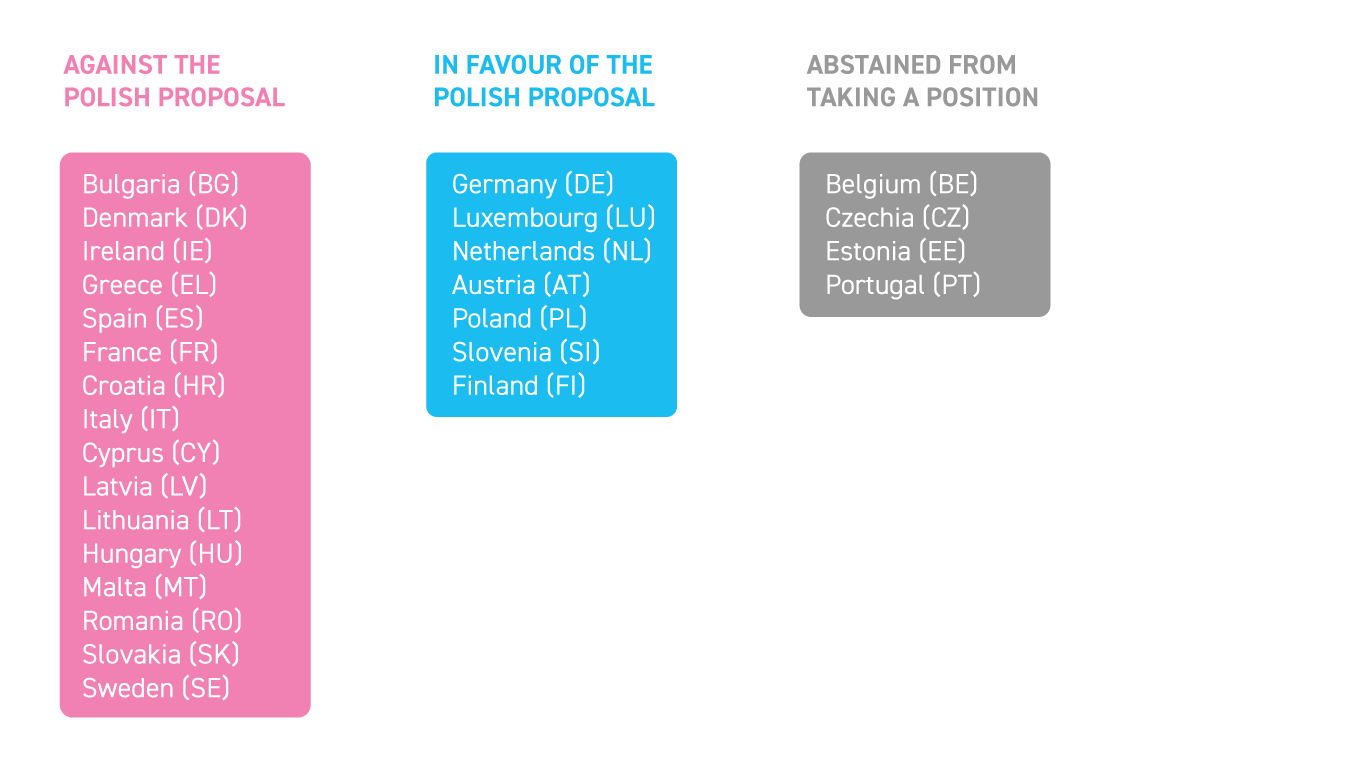
Council agreement requires at least 15 member states representing a minimum of 65 percent of the EU population. The 11 countries that actively supported or abstained on Poland's text account for only 42.43 percent of the population, falling short of the 15-country threshold. This shortfall, however, carries positive implications: it demonstrates that countries representing nearly half the EU's population reject untargeted detection orders and encryption breaking.
The pro-Chat Control coalition comprises 16 member states but represents only 57.57 percent of the population, also insufficient to meet the threshold. The 11-country blocking minority therefore prevents the pro-Chat Control camp from securing the necessary majority.
Population-weighted voting means that only three scenarios could move the regulation forward:
- Germany or Poland shifts its position
- The Netherlands and at least two other smaller countries change course
- At least four additional member states switch sides
Several upcoming political developments warrant close monitoring:
- Belgium's new government coalition agreement identifies CSA as a "high priority" requiring "support for EU-level work," though implementation details remain unspecified
- Germany's incoming government has not yet announced an official position
- Czechia will hold parliamentary elections on 3–4 October 2025
- The Netherlands faces elections on 29 October 2025 following the recent government collapse
These governmental transitions necessitate sustained national advocacy to prevent member states from accepting any CSA Regulation text that permits mass surveillance or undermines end-to-end encryption.
What the Polish failure signals
Prior to Poland's presidency, every Council presidency had advanced compromise texts aligned with the Commission's original proposal, despite the Council Legal Service's harsh assessment and the existence of a well-established blocking minority. Six consecutive presidencies—Hungary, Belgium, Spain, and others—pursued Chat Control without achieving majority support.
Poland's departure from this pattern was encouraging. Yet its failure means the stalemate will persist indefinitely. While this outcome protects against Chat Control's passage, it leaves unresolved the serious challenge of addressing online child sexual abuse material.
A logical path forward would involve member states requesting that the Commission withdraw its original proposal—as France has done—and collaborating with stakeholders to develop substantive solutions addressing the underlying problem.
Source: EDRi (European Digital Rights)