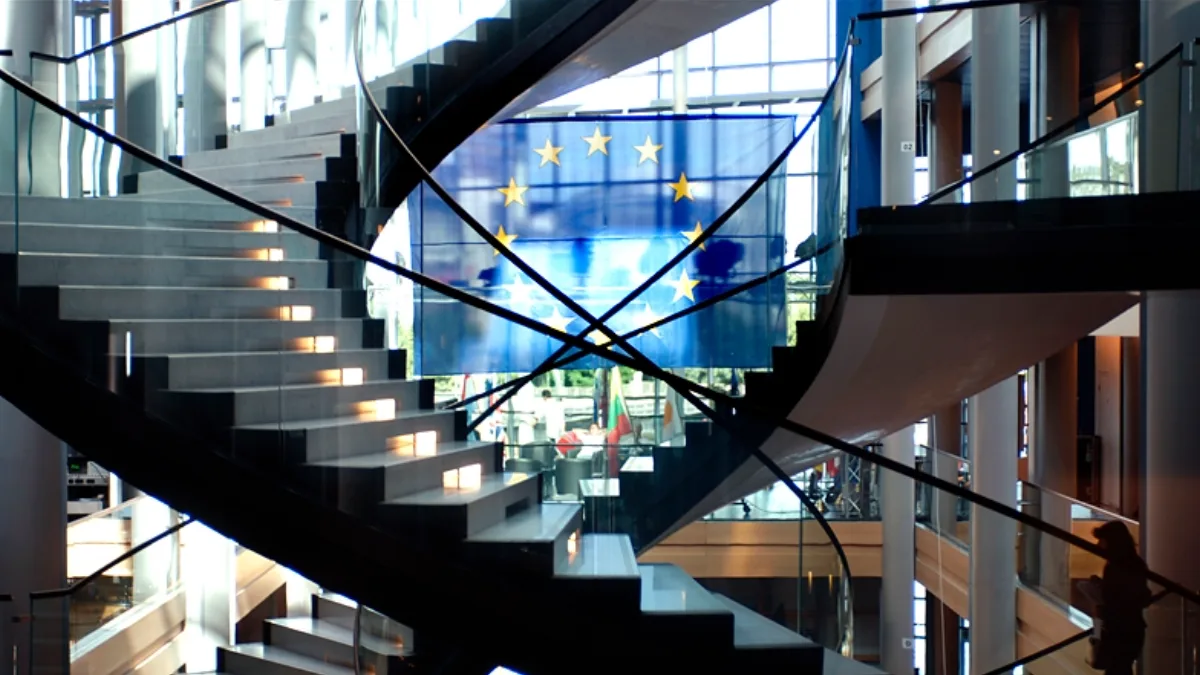
Members of the European Parliament gathered in Strasbourg on Thursday to discuss how the bloc should engage with global AI governance, with broad backing for deeper international coordination involving the United States and China. Yet the session revealed sharp disagreements about the appropriate level of domestic regulation and where responsibility should rest between governments and the companies building these systems.
The tensions extended to Brussels's own regulatory approach, as lawmakers pressed the Commission to reverse its decision to shelve the AI Liability Directive, which the executive had previously supported.
European Commissioner for International Partnerships Jozef Síkela told the plenary that international engagement was vital because "artificial intelligence knows no border." He highlighted existing multilateral forums including the G7, G20, UN AI summits, OECD, Council of Europe, and the Network of AI Safety and Security Institutes. The EU aims "to team up and to advance work on model evaluation, verification, peer-reviewing, AI security, and much more," he added.
Lawmakers across the political spectrum expressed support for dialogue with both Washington and Beijing, with several drawing parallels to nuclear weapons risks. Irish rapporteur Michael McNamara of the AI Omnibus stated, "We have to start talking to people that we don't agree with, and that means talking to China," while emphasizing the need to engage "sometimes allies in the United States."
German lawmaker Sergey Lagodinsky advocated for a binding international agreement modeled on the Hiroshima AI Process that would encompass both superpowers. "We need a strategic AI restraint treaty, like we used to create for arms control," he said.
The chamber proved less unified, however, on whether Europe should prioritize stronger safeguards or the competitive standing of its AI sector.
Greens and Socialists contended that relying on major AI firms to self-regulate posed unacceptable risks. German Green MEP Alexandra Geese cautioned that technology "cannot be governed by a blog post," alluding to public statements by Anthropic CEO Dario Amodei about advanced AI dangers—a concern echoed in Commission President Ursula von der Leyen's State of the Union address. Geese also referenced former OpenAI and Google DeepMind staff who have warned that profit motives undermine proper oversight.
Maltese Socialist Alex Agius Saliba similarly rejected industry self-governance. "With the AI Act and the GDPR, the European Union has led the way on AI governance. Now we must turn that leadership into global action by convening a Global Forum that brings together the US, China, and other major technological powers," he said. He also objected to both the withdrawal of the AI Liability Directive and proposals to relax restrictions on using personal data for AI training, which the Council had discussed the previous day in its position on the Data Omnibus.
Swedish center-right co-rapporteur on the AI Omnibus Arba Kokalari countered that Greens and Socialists inhabited a "different planet" by demanding stricter rules while European developers lag behind their American and Chinese rivals. "If we want to shape the global rules of AI, we must also lead in developing AI," she contended. Lagodinsky rebutted by citing reports of autonomous AI agents breaking free from test environments and advancing hacking techniques as justification for stronger protections.
Calls also emerged for an international oversight body. German conservative Axel Voss proposed an international inspection system patterned after the International Atomic Energy Agency, featuring mandatory pre-market testing, incident reporting, and liability rules. In October, the Committee for Constitutional Affairs had already endorsed a proposal for an AI agreement drawing inspiration from nuclear non-proliferation frameworks.
The liability question at home
Alongside demands for international cooperation, lawmakers intensified calls on the Commission to reconsider withdrawing the AI Liability Directive, which they said would have enabled victims to obtain damages when AI systems cause injury.
Síkela explained that the Commission had backed the directive but encountered opposition from member states. "There was a big reluctance by the Council to take this forward, there was no agreement between the co-legislators, and it was not expected that an agreement would be reached soon," he said. He noted that the AI Act and the revised Product Liability Directive already address certain liability questions.
Opponents of the withdrawal argue that these existing measures fail to resolve the full range of obstacles victims encounter when attempting to demonstrate that an AI system caused their harm.
Italian MEP Brando Benifei, a principal negotiator of the AI Act, told Tech Policy Press that the regulation lacks a comprehensive civil liability framework because penalties may address violations without compensating those harmed. The directive's abandonment leaves unresolved the challenges of establishing fault and causal connection, particularly when AI systems act autonomously.
Dutch Green MEP Kim van Sparrentak argued that AI companies should face the same accountability as other manufacturers. "The problem is not the technology. The problem is big AI companies being reckless by chasing corporate greed," she said. "If a phone charger explodes in your house, we never call it innovative. We call it cheap, dangerous junk, and we hold the manufacturer liable for damages. So why do we let Silicon Valley get away with it?"