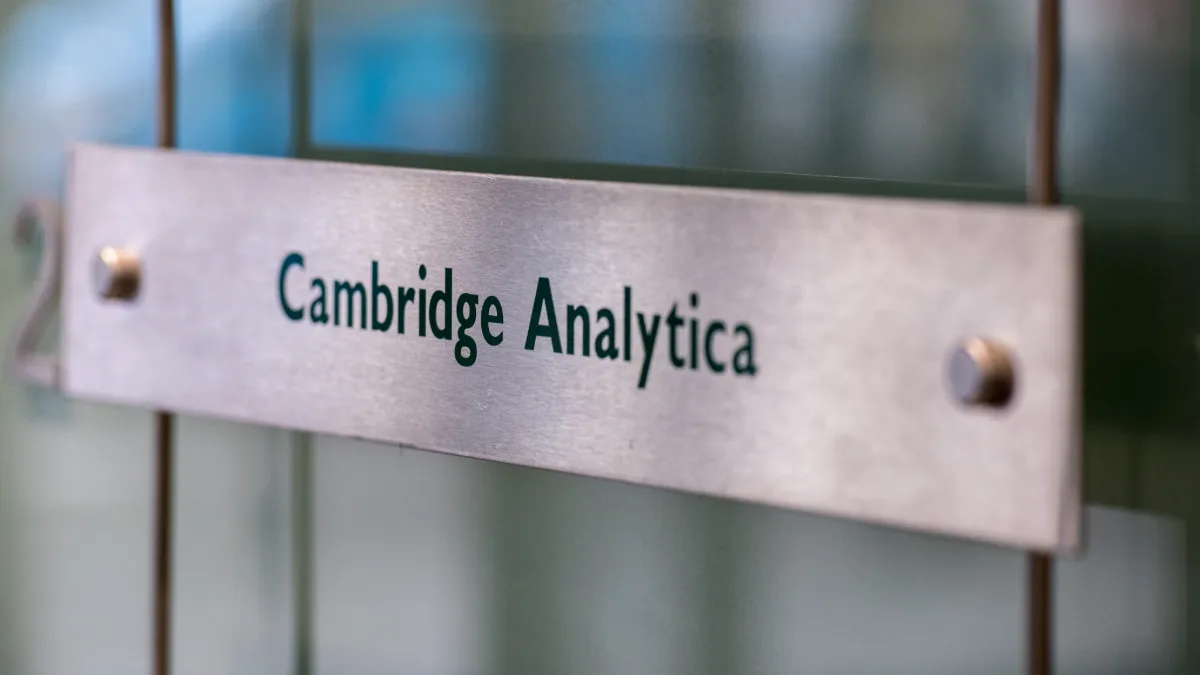
The word "Cambridge" appears 45 times throughout the 130-page, $17 billion settlement Meta reached with 52 states and territories over child harms. That repetition points to something unexpected: nestled inside this massive agreement sits a separate settlement worth $459,293,017.80 to address state claims stemming from the Cambridge Analytica scandal.
The child safety settlement treats Cambridge Analytica with unusual specificity. It defines "Cambridge Complaints," "Cambridge Releasors," "Cambridge Settlement Amount" and "Cambridge Settling States" in meticulous detail. Exhibit E allocates the nearly $459.3 million among 46 states and two territories. In return, participating states release Meta from Cambridge Analytica-related claims broadly, including future claims based on facts not yet known.
Cambridge Analytica may seem like a relic from another era. In 2019, Facebook faced a record $5 billion Federal Trade Commission penalty. The same day brought a $100 million Securities and Exchange Commission settlement over misleading disclosures about user data risks—a resolution that drew far less attention. Congress and most media outlets moved forward, though the scandal acquired meme-like status in public discourse while factual understanding grew muddled.
The courts, however, never moved on. Nearly a decade of litigation has constructed a historical record far more complete than what existed when Mark Zuckerberg testified before Congress in 2018, weeks after global headlines erupted. Meta's continued payments in 2026 demonstrate that the scandal extended beyond Cambridge Analytica itself. The underlying questions persisted: What knowledge did the company possess about data flows through its platform? When did leadership and the board learn critical facts? What representations did Facebook make to users, investors and regulators? How did executives respond when these practices threatened the organization?
Litigation Across Multiple Fronts
- A consumer class action over Facebook's third-party data sharing produced a record $725 million settlement.
- The District of Columbia Office of the Attorney General pursued multiple cases that stalled for years before revival in appeal, including efforts to hold Zuckerberg personally liable.
- Meta shareholders sued Facebook's directors in Delaware, alleging the board agreed to pay billions more to the FTC in exchange for shielding Zuckerberg from personal accountability. This case yielded its own $190 million settlement in July after Meta threatened to leave the state and as trial commenced with a key board member preparing to testify.
- California shareholders continue pursuing accountability after the Supreme Court rejected Meta's bid to end the case, possibly reflecting uncertainty about Facebook's knowledge of its practices.
Litigation has also brought to light Facebook's internal response to Cambridge Analytica, information that never received the attention of the original scandal. Following the March 2018 disclosure, Zuckerberg announced to Congress an unprecedented investigation of apps to determine whether other Cambridge Analyticas possessed access to vast quantities of user data. Five years later, litigation surfaced the internal app audit report that Meta had fought to keep sealed. The report revealed enormous risk: tens of thousands of developers tied to Iran, China, Russia and North Korea had accessed user data. Senators Mark Warner (D-Va.) and Marco Rubio (R-Fla.) sent a letter. Few took notice. The audit meant to demonstrate whether Cambridge Analytica represented an aberration largely vanished from public consciousness.
Litigation also raised questions about evidence handling. In Delaware last year, former Facebook COO Sheryl Sandberg faced court sanctions after "the judge said evidence showed Sandberg used a personal account under a pseudonym and erased messages that were likely relevant to the shareholder lawsuit." A California district court imposed similar sanctions on Facebook's law firm Gibson Dunn and the company months before settlement. The Judge characterized this as a "sustained, concerted, bad-faith effort to throw obstacle after obstacle in front of the plaintiffs—all in an attempt to push the plaintiffs into settling the case for less than they would have gotten otherwise." The pattern resembled Meta's infamous "delay, deny and deflect" approach.
Zuckerberg's own SEC deposition regarding Cambridge Analytica, conducted in 2019, remained confidential for years. The transcript emerged reluctantly in 2022 after the SEC faced a Freedom of Information Act lawsuit. The public then learned that Zuckerberg had removed Cambridge Analytica references from prepared remarks for a significant video address in 2017, when mentioning the scandal would have seemed premature. Sheryl Sandberg's SEC deposition from one week earlier in 2019 remains sealed. The public cannot compare how Sandberg's testimony aligned with Zuckerberg's answers. These details illustrate the substantial gap between a scandal's initial lifecycle and the actual evidence trail that emerges through legal processes.
The Settlement as Closure
When scandals break, reporters uncover whatever they can, sometimes aided by whistleblowers accepting significant risk. Congressional hearings occur quickly while public anger remains high. CEOs arrive with carefully prepared testimony, coached by experts with deep legislative access. Regulators face pressure to act. Then comes a major settlement—the dollar figure becomes the headline. Some declare accountability achieved, others debate the amount, but most people except lawyers move forward.
Courtrooms and discovery operate on different schedules. Documents emerge. Emails surface. Executives face depositions. Board and leadership discussions become evidence. Crisis-era statements get tested against documents later revealed.
This week's $459 million Cambridge Analytica settlement warrants greater scrutiny than it will likely receive. Meta demonstrated willingness to pay hundreds of millions more to close the book on these state claims. The states now agree to "fully, finally, and forever" waive, settle, release and discharge all Cambridge Analytica related claims that may exist even if they "do not, for any reason (including, without limitation, ignorance, oversight, error, negligence or through no fault whatsoever)" know or suspect to exist. Essentially, states acknowledge that future facts may differ from current knowledge. This does not include Washington, D.C. Attorney General Brian Schwalb's case against Zuckerberg and Facebook, which has an important hearing scheduled for September followed by additional depositions and discovery, and New Mexico's trial set to commence September 8, as reported by Bloomberg.
Legitimate reasons exist for attorneys general to settle. Litigation demands resources, moves slowly and carries unpredictability. However, settlements should not be confused with complete historical accounting. Meta's financial resources and public relations capacity should not substitute for examining individual responsibility, corporate behavior and what newly uncovered evidence reveals about the scandal.
Implications for AI and Future Accountability
This lesson carries particular weight now. Meta and other technology companies are developing artificial intelligence systems whose value depends heavily on massive data quantities, high-quality content and public trust. Publishers and creators already dispute whether their work can be taken and used to train and build these products, including Meta's offerings, without permission or compensation.
The legal questions differ from Cambridge Analytica. The accountability challenge, however, feels familiar. Technology advances rapidly even as it damages things in the rush to scale. The public receives asked to trust representations about what occurred and why. They receive asked for forgiveness later. The legal system may require years to reveal underlying evidence.
Waiting that long should not be necessary this time. Facebook changed its name. Cambridge Analytica ceased operations. Headlines vanished years ago. Yet in August 2026, Meta pays $459,293,017.80 to finally resolve Cambridge Analytica claims, a result buried inside one of the largest consumer-protection settlements in history for a completely separate matter. Cambridge Analytica never truly disappeared—it simply faded from immediate view while legal processes continued their work.