Petra Molnar and Liz Carolan are fellows at Tech Policy Press.
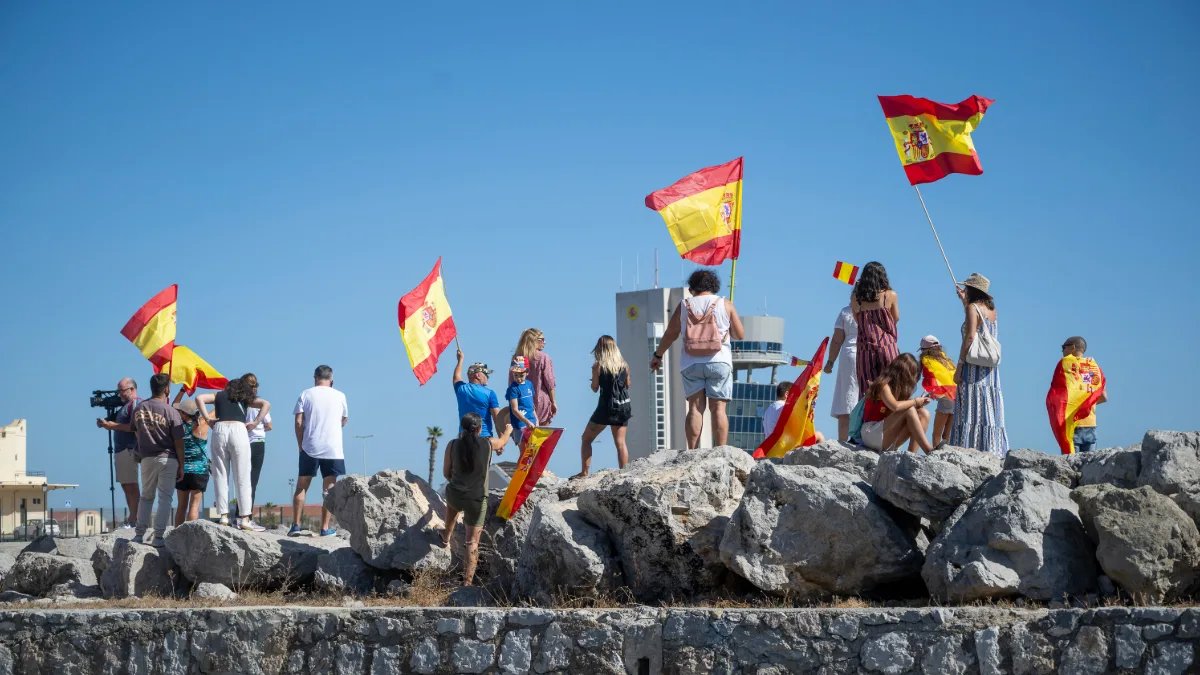
During a two-day period in late July, approximately 72,000 individuals made their way across the Morocco-Ceuta border, with many attempting the perilous five-kilometer sea crossing. The enclave's mayor reported that at least 100 people died in the attempt. Prior to this surge, social media platforms circulated false narratives claiming that a Spanish Supreme Court decision had effectively opened Ceuta's borders to Europe, and that entry would prove straightforward.
Spain's Prime Minister Pedro Sánchez this week publicly identified the disinformation sources, drawing on research from the European External Action Service. According to his statement, Russian and Israeli networks collaborated with what he termed an ultra-right international coalition that weaponizes migration as a tool against Spain and Europe. Sánchez attributed the campaigns to Madrid's stances on Ukraine and Gaza, while noting investigators had found no evidence of Moroccan government participation. Gideon Sa'ar, Israel's Foreign Minister, dismissed the claim, stating that Sánchez was "lying shamelessly," and Russia similarly denied involvement.
The disinformation playbook deployed in Ceuta mirrors tactics used to target migrants heading toward the United States. In both contexts, these campaigns gain traction not because audiences lack critical judgment, but because border policies themselves remain deliberately obscure, constantly shifting, and poorly explained—making a video from an unknown source often the most reliable information available.
Spanish outlet El Español documented dozens of throwaway accounts on TikTok and Instagram posing as young Moroccan travelers celebrating their arrival in Ceuta. Formatted as influencer content, these videos offered practical guidance on crossing—what to bring, how to help non-swimmers and children. Though platforms removed many accounts, they promptly resurfaced under different names.
Reuters reporting revealed that young people traveled substantial distances in response to online rumors. Waitress Dounia Kherradi drove nine and a half hours from her home, while 16-year-old Ayoub El Abyad and his cousin drove 12 hours after viewing Instagram videos. Upon arrival, reality diverged sharply from the polished reels they had seen. Migrants told DW News they encountered corpses during the swim, faced violence upon landing, and were refused service at shops. They discovered no onward path to Europe existed and that the promises had been fabricated. By weekend's end, nearly all but a few thousand had returned to Morocco.
The mechanics visible at Ceuta follow a well-established pattern also evident in content targeting U.S.-bound migrants. In March of the previous year, the Associated Press examined hundreds of TikTok videos from Mexican migration facilitation networks, identifying matching visual and narrative elements documented by El Español on the Moroccan side: upbeat music, emoji-filled text, dune buggies racing toward barriers, jet skis and helicopters, tunnels marketed as premium services, facilitators slicing open cacti for water, fields captioned "The American fields are ready!," and testimonials from satisfied customers.
Whether in Ceuta or the Americas, such videos and images function as marketing materials, presenting border crossing as a solvable logistical challenge with a positive resolution.
The commercial dimension of this content is well understood. Spain's Prime Minister initially attributed the disinformation to human-trafficking organizations positioned to profit from crossing attempts.
Research has shown that Meta generated revenue from smuggling and fraud advertisements aimed at people seeking U.S. entry, with this activity accelerating once asylum processing became dependent on a single mobile application. When CBP One became the primary mechanism for border appointments, a parallel economy emerged: counterfeit appointment confirmations sold to arrivals with nothing awaiting them, paid intermediaries charging from minimal amounts to thousands of dollars, and GPS-spoofing techniques shared via WhatsApp by those excluded from the app's geographic restrictions. The Tech Transparency Project documented Facebook and WhatsApp filled with false policy announcements and fabricated provisions for pregnant women and parents with children.
The July rumor in Morocco—that a court decision had quietly created a crossing route—exemplifies a documented phenomenon, yet coverage of Ceuta has largely sidestepped the underlying difficulty. Misleading information does not reach migrants through isolated channels separate from legitimate content; it arrives through identical feeds, matching visual styles, and frequently from accounts indistinguishable at first glance.
Consider the Venezuelan and Colombian creators who filmed their own Darién Gap crossings, some accumulating tens of millions of views. Their videos served as practical manuals detailing shelter options, transport costs, river routes, and money transfer locations. Many explicitly stated they were discouraging rather than encouraging travel. The associated hashtag received close to half a billion views. For many people, this platform and format represents the sole accessible information source about the journey—available in their language, within their budget, from someone in comparable circumstances.
Characterizing the young Moroccans as merely "duped" therefore becomes untenable. Scholarship examining refugee smartphone use employs a specific concept for their situation. Researchers including Marie Gillespie, Souad Osseiran, and Margie Cheesman describe information precarity—a persistent state of informational instability where migrants depend on peer networks because official sources are inaccessible, untranslated, contradictory, or deliberately hostile. Exposure to rumor and disinformation stems from this identical structural absence.
The informational vulnerability originates from a legal framework providing virtually no authoritative, usable guidance on entry eligibility and procedures. In Ceuta, Dounia Kherradi's nine-and-a-half-hour drive was motivated by online content because no alternative existed. Decision-making within informational scarcity remains agency, and critiques of disinformation campaigns must avoid reproducing the colonial tendency to attribute the problem to supposed credulity of people from the Global South rather than to systems engineered to keep them uninformed.
States themselves rank among the most prolific contributors to this information ecosystem. In 2025, the U.S. Department of Homeland Security allocated up to $200 million for a two-year domestic and international advertising initiative featuring Secretary Kristi Noem declaring "we will hunt you down," delivered through precision-targeted social media and text messages alongside traditional broadcast media.
When these advertisements aired during prime-time football on Mexican television, President Claudia Sheinbaum moved to prohibit foreign government propaganda, reinstating a provision eliminated in 2014. Deterrence messaging and smuggler promotion operate on identical infrastructure, reach identical audiences using identical behavioral techniques, and make competing assertions about border outcomes.
The thousands of Moroccans in July faced the equivalent campaign that, in the Americas, commands $200 million in funding. Neither campaign conveyed what the law actually permitted; both constituted persuasion financed and targeted by parties with political stakes in the result. No authority in Rabat, Madrid, or Washington bore any duty to furnish people with authoritative, timely, and usable information, and consequently, none did.
Source: Tech Policy Press