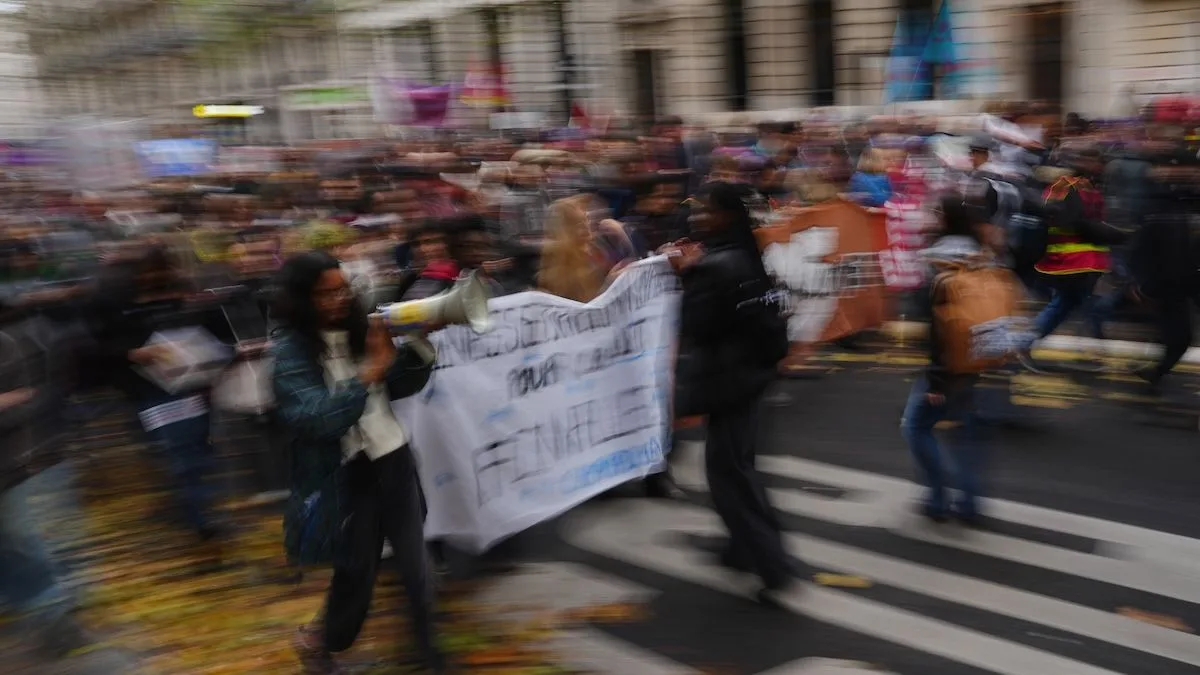
Across France and beyond, young people have mobilized in unprecedented numbers to challenge education cuts and rising living costs. What began as a single school protest in the Paris suburbs has grown into a nationwide movement, with hundreds of thousands taking part. Similar youth-driven demonstrations have erupted in Chile, Greece, Italy, and India, where anger over education policy and examination systems has gathered enough momentum to force ministerial resignations. The scale rivals the student uprisings of 1968, when movements in Paris, Prague, and the United States challenged war, authoritarianism, and social injustice.
Today's protesters possess a tool their predecessors lacked: social media. Young people coordinate action through Instagram, TikTok, and X, while initial organizing in France occurred via Snapchat, where students shared complaints about absent teachers and inadequate facilities before arranging meeting points. Yet this advantage has prompted alarming responses from authorities worldwide, who are moving to restrict or ban platform access for minors.
Why Social Media Matters for Youth Political Power
For young people, these platforms serve functions far beyond protest logistics. They enable discussion of policy, criticism of government decisions, petition circulation, and connection with like-minded peers. For many—those requiring parental permission to attend rallies, living in areas with poor or unsafe transit, or lacking other avenues for political expression—online participation represents the only viable channel for civic engagement.
Minors occupy a distinct political position. They cannot vote, hold office, or command the financial resources and mobility adults possess. They have limited ability to reach elected representatives. Yet a teenager with a smartphone can produce viral content, coordinate mass action, and amplify messages to millions. International human rights law, including the UN Convention on the Rights of the Child, recognizes that children retain rights to expression, assembly, and association regardless of age. National constitutions, including France's, extend these protections to all citizens, including those under 18.
The Global Push for Age Restrictions
Governments in France, Australia, the United Kingdom, Malaysia, Greece, India, and Chile have pursued or adopted bans preventing access for those under 15 or 16. Multiple U.S. states have attempted comparable legislation. However, not all survive judicial review. France's highest court struck down the country's attempt to block social media for under-15s over the summer, determining the measure violated freedom of expression and communication in a manner disproportionate to its aims.
Real Harms, Flawed Solutions
The dangers motivating these restrictions are genuine. Young people encounter sexual exploitation, privacy breaches, and mental health deterioration online. Governments hold legitimate authority to mitigate such harms. However, blanket age-based bans represent an excessive response that disregards young people's capacity to speak, assemble, and organize—particularly during periods of significant political transformation. Removing an entire generation from major communication infrastructure is not a narrowly calibrated safety measure; it constitutes a substantial impediment to political participation and risks silencing youth precisely when their voices matter most.
Bans as Tools of Suppression
Evidence suggests governments are weaponizing restrictions against youth activism rather than deploying them for protection. French officials, recognizing social media's role in mobilizing demonstrators, have pursued direct pressure on companies, renewed calls for age-based blocking, and contemplated total platform shutdowns to disrupt organizing. Similar patterns appear elsewhere: Indian authorities have severed internet access, ordered mass deletion of anti-government posts, and considered age restrictions on services. In this context, bans function as censorship mechanisms and gatekeeping devices for political participation.
While 1968 governments deployed military force, police violence, and mass detention, today's restrictions may prove more strategically effective. By severing young people from the communication networks through which they locate allies, coordinate action, and exchange ideas, authorities can preempt movements before they reach public spaces. The political consequences extend beyond one generation: suppressing the rights of youth erodes fundamental freedoms for all.