Digital communications platforms have fundamentally altered the flow of information between people, reshaping how societies understand problems and reach agreement on solutions. More than a dozen scholars across multiple institutions now contend that investigating technology's influence on collective behaviour merits classification as a "crisis discipline," warning that "the vulnerability of these systems to misinformation and disinformation poses a dire threat to health, peace, global climate and more." They are urging both academics and technology executives to adopt a Hippocratic oath pledging to avoid causing harm.
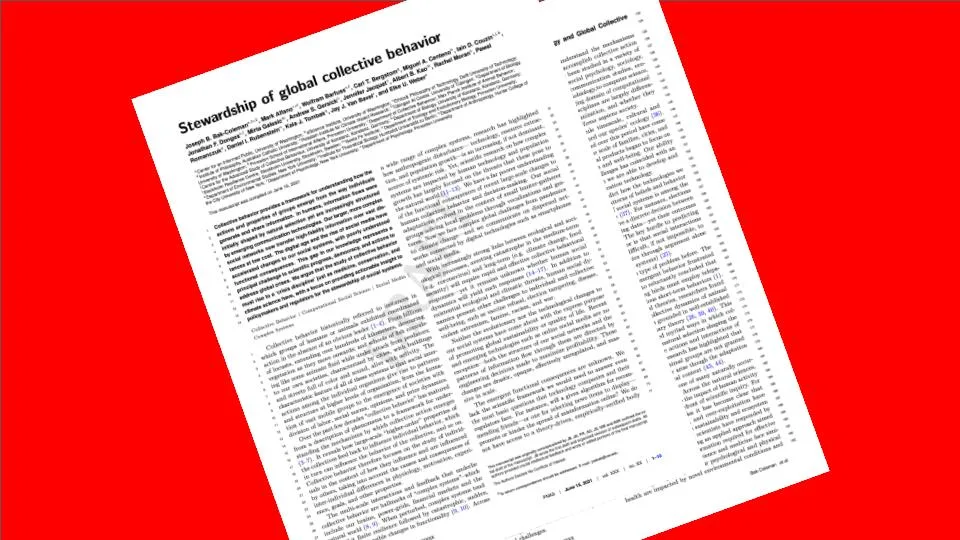
In a forthcoming paper in the Proceedings of the National Academy of Sciences titled Stewardship of global collective behavior, the researchers observe that human social instincts developed within small groups relying on face-to-face communication. "Now we face complex challenges from pandemics to climate change—and we communicate on dispersed networks connected by digital technologies and social media," they write. The paper identifies vaccine hesitancy, electoral disinformation, racism and violent extremism as evidence of how technology-driven information systems have created societal vulnerabilities.
Joseph B. Bak-Coleman, lead author and post-doctoral researcher at the University of Washington's Center for an Informed Public, stated: "We have built and adopted technology that alters behavior at global scales without a theory of what will happen or a coherent strategy for reducing harm." The researchers emphasize that current systems prioritize corporate profit over public welfare, with social consequences that remain largely opaque and unregulated.
Five structural shifts in human communication
Drawing comparisons to collective behaviours in nature—from fish schools to bird flocks—the paper identifies five key transformations wrought by digital technology:
Scale of connection
Human networks have expanded dramatically within decades, a fraction of the 12,000-year span during which societies developed their institutions. The researchers note that "expanding the scale of a collectively behaving system by eight orders of magnitude is certain to have functional consequences," potentially undermining groups' capacity for sound decision-making, consensus-building and cooperation.
Network topology
Throughout human evolution, individuals maintained meaningful relationships with at most hundreds of others. Contemporary platforms enable novel connection patterns, creating both opportunities—linking people whose identities or beliefs isolate them locally—and risks including "echo chamber and polarization, eroded trust in government, world-wide spread of local economic instabilities, global consequences of local electorate decisions, difficulty coordinating responses to pandemics."
Information quality and speed
Early human communication moved slowly through biological channels—speech, gesture, vocalisation—and degraded naturally as it spread. This degradation served a protective function: "evidence from fish schools revealed that noise and decay are important for preventing the spread of false alarms." Modern digital systems eliminate such friction, potentially "overwhelm[ing] cognitive processes and yield[ing] less accurate decisions" while removing traditional filters on information circulation.
Algorithmic systems
Platforms have outsourced human information-seeking to algorithms designed primarily for revenue generation rather than societal benefit. The researchers conclude: "Given that algorithms and companies are already altering our global patterns of behavior for financial reasons, there is no safe hands-off approach."
Toward a new framework
The researchers propose treating technology's impact on collective behaviour as a crisis discipline alongside medicine, conservation biology and climate science. This interdisciplinary effort should draw from computational social science, technology studies, economics, law, public policy, systemic risk and international relations.
They advocate for a "Hippocratic oath for anyone studying or intervening into collective behavior, whether from within academia or from within social media companies and other tech firms. Decisions that impact the structure of society should not be guided by voices of individual stakeholders but instead by values such as non-maleficence, benevolence, autonomy and justice."
Carl T. Bergstrom, a University of Washington biology professor and co-author, remarked: "We urgently need to understand this and move forward with focus on developing social systems that promote well-being instead of creating shareholder value by commandeering our collective attention."
The authors warn that "inaction on the part of scientists and regulators will hand the reins of our collective behavior to a small number of individuals at for-profit companies."
Additional contributors include Rachel Moran (University of Washington); Mark Alfano (Delft University of Technology and Australian Catholic University); Wolfram Barfuss (University of Tübingen); Miguel A. Centeno, Andrew S. Gersick, Daniel I. Rubenstein and Elke U. Weber (Princeton University); Iain D. Cousin (University of Konstanz); Jonathan F. Donges (Stockholm University); Mirta Galesic and Albert B. Kao (Santa Fe Institute); Pawel Romanczuk (Humboldt Universität zu Berlin); Kaia J. Tombak (Hunter College of the City University of New York); and Jay J. Van Bavel and Jennifer Jacquet (New York University).
Source: Tech Policy Press