The pursuit of artificial intelligence leadership is driving India's infrastructure agenda. State governments across the nation are locked in competition to secure data center investments, dangling offers including discounted land, infrastructure designation, tax breaks, and pledges to boost power generation. By the close of 2025, investment pledges had reached US$126 billion, with projections pointing toward US$180 billion in 2026. Installed capacity is forecast to expand nearly fivefold over the coming decade. Maharashtra, Tamil Nadu, Karnataka and Andhra Pradesh have each rolled out tailored policies and major funding packages to position themselves as India's premier AI infrastructure destinations.
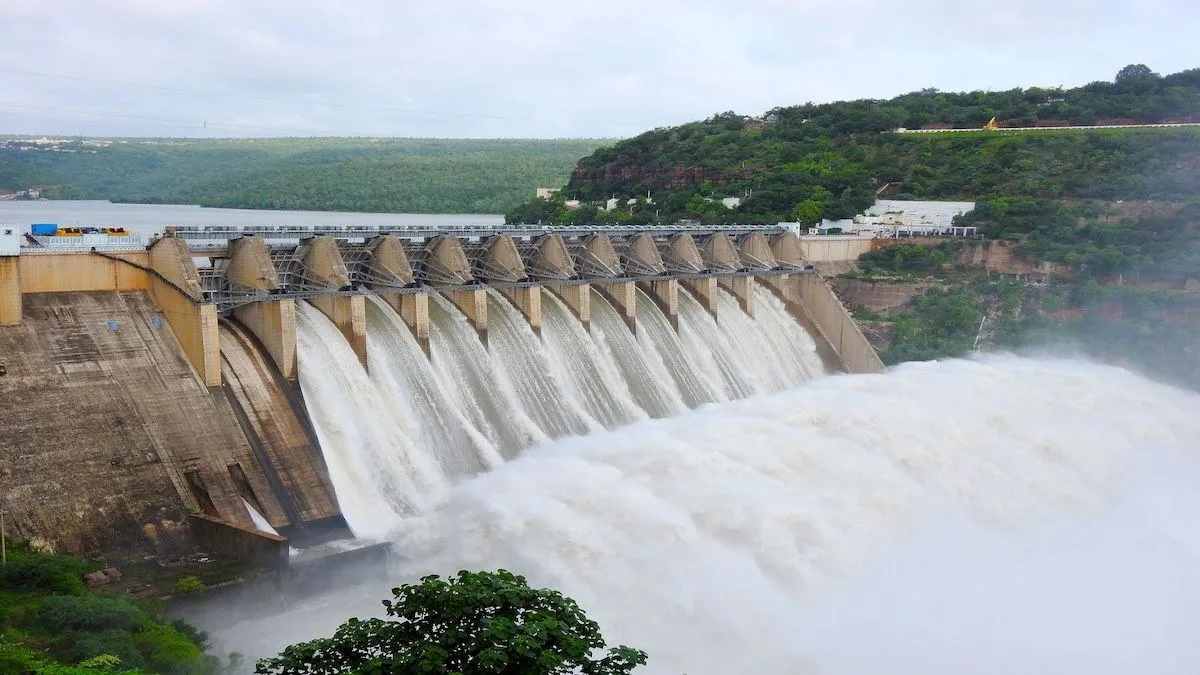
This infrastructure push echoes an earlier chapter in India's development story. When Jawaharlal Nehru, the nation's founding Prime Minister, called large dams the "temples of modern India" in 1954, he captured their symbolic weight in the post-independence development model. The construction effort was staggering: India possessed fewer than 300 large dams upon independence in 1947, yet had built more than 4,000 by 2000, with the majority completed during the 1971–1989 window.
Today's data centers occupy a comparable position in national strategy. They represent the physical foundation for India's AI aspirations and receive active backing through government industrial policy. Like the dams of the post-independence decades, data centers demand substantial capital investment and state backing, and they are framed as engines of national transformation. Both types of infrastructure concentrate resources and promise nation-level returns rather than immediate local advantage.
Viewing data centers through India's longer infrastructure trajectory surfaces persistent questions: What governance structures suit projects of this magnitude? How do societies balance environmental and social consequences against national goals? And through what mechanisms should gains be distributed across the population?
National ambitions, local costs
The rhetoric around major infrastructure typically operates at the national register. The Bhakra Nangal and Sardar Sarovar dams were marketed as contributions to electricity supply, agricultural irrigation and broader national progress. Data centers are promoted as tools for digital self-sufficiency, foreign capital attraction, employment creation and computational capacity for an AI-driven economy. State authorities increasingly frame them as catalysts for wider digital and industrial ecosystems, even as environmental concerns have sparked demonstrations and court challenges in India and prompted calls for building freezes elsewhere.
These national-level objectives carry weight, yet India's track record with large infrastructure reveals a more complicated picture. Massive projects typically distribute gains and burdens unequally. National metrics—investment flows, GDP growth, expanded connectivity—coexist with local realities: altered land use, diminished water access, elevated electricity consumption and degraded environmental quality in host areas.
The dam experience makes this geographic imbalance stark. Dams delivered power and irrigation to distant regions while nearby populations absorbed displacement and ecological damage. Data centers follow a different pattern but share the same fundamental dynamic: investment, resource consumption and environmental strain concentrate in specific locations, while benefits spread across the nation and beyond. Two cities—Mumbai and Chennai—house roughly two-thirds of India's data center stock, and many new and planned facilities sit in water-scarce regions.
Mumbai exemplifies the tensions this concentration creates. The city has emerged as India's primary data center hub owing to its connectivity infrastructure and consistent policy backing, yet its expansion has intensified disputes over electricity consumption, public spending and the use of constrained urban resources. Unlike dams, which displaced populations to create reservoirs and generate electricity, data centers compete through quieter mechanisms—bidding for land, water quotas and discounted power. Yet the outcome parallels the dam experience: host regions shoulder concentrated resource demands while economic gains flow elsewhere—into corporate profits and investor returns, or into digital services consumed far from the infrastructure itself.
This matters because AI infrastructure relies on resources distributed unequally across the globe. India holds roughly 18 percent of the world's population but only around 4 percent of its freshwater. Data center water consumption is set to more than double within five years, climbing from approximately 150 billion liters in 2025 to around 358 billion by 2030. Electricity demand will rise from about 0.8 percent of national consumption to over 2.5 percent, intensifying strain on a power grid still heavily reliant on coal. These pressures will be felt most acutely by the regions hosting the facilities rather than by distant users who benefit from them.
Rather than focusing solely on how many data centers India should construct, policymakers must address where they are sited, how resources are distributed, and whether host communities gain a share of the value they create.
Governing infrastructure
The shift from planning to execution exposes governance gaps. A major AI data center project in Visakhapatnam demonstrates the problem. Its environmental approval proceeded without public consultation because regulators classified it as a building rather than infrastructure requiring deeper environmental review. The dispute raises fundamental questions about whether current regulatory systems can manage infrastructure at this scale.
Comparable tensions marked India's dam-building era. The Sardar Sarovar project endured decades of litigation, environmental investigation and conflict over who would be displaced and how they would be compensated before completion. These disputes were not mere impediments to construction. They forced societies to confront who bears the costs, whose voices matter in decision-making, and what obligations developers and states owe to affected populations.
The analogy has limits
While dams and data centers share characteristics as "mega infrastructures," their differences reveal how far India has shifted toward market-driven development.
Funding
Historically, the Government of India financed and built large dams directly. Data centers rely predominantly on private corporate funding—American technology giants and Indian conglomerates like the Adani Group—while governments supply land, tax relief and electricity. The state has transitioned from owner-operator to enabler of privately financed infrastructure.
Control over output
Dam-generated electricity flowed into publicly managed distribution networks. Data centers generate privately owned computing capacity whose allocation remains opaque. Will Indian startups and research institutions gain access, or will it primarily serve the owning corporations? What entitlement does the public have over infrastructure built with subsidized land, water and power?
Contestation
Public campaigns against the Sardar Sarovar Dam eventually forced acknowledgment of displacement and community resettlement. Opposition to data centers has faced easier suppression or reframing as anti-development sentiment—or even as "anti-national."
Data centers align more closely with India's Special Economic Zones—state-controlled enclaves offering land, infrastructure, tax advantages and regulatory flexibility to attract private investment. These zones have themselves sparked some of India's most violent protests. They became central to the growth of India's globally oriented service sector. Data centers extend this model into the digital realm, again mobilizing public resources for privately controlled infrastructure.
Governing the next infrastructure transition
Beyond the question of whether India should build data centers lies the question of how to govern them. The rapid expansion of AI has created urgency. Governments race to attract investment while developers rush to expand capacity. Yet India's infrastructure history suggests that governance issues deferred do not vanish; they resurface through lawsuits, public resistance, environmental crises or costly policy reversals.
India possesses substantial experience addressing the social and environmental dimensions of large infrastructure. Conflicts over dams shaped policy discussions and frameworks around environmental review, public participation, rehabilitation and compensation. This body of experience offers lessons to draw upon.
Internationally, governments have experimented with distributing infrastructure benefits more widely. Nepal has implemented local ownership stakes and royalty arrangements for hydroelectric projects. Wales is exploring community ownership mandates for large renewable energy facilities. These are not turnkey solutions for data centers, but they demonstrate that infrastructure benefits are shaped by policy choices, not predetermined outcomes.
As India's AI infrastructure expands, the task is not merely to accelerate construction but to do so responsibly. This requires acknowledging the demands data centers place on land, water and electricity; demanding transparency in environmental performance; mandating genuine public consultation before approvals; tracking environmental and social effects during operation; and designing mechanisms for host communities to capture a direct share of the value generated.
It also requires protecting space for public debate and challenge. As India's earlier infrastructure conflicts have demonstrated, opposition can illuminate overlooked harms and force questions of responsibility and openness into the open.
The technology is novel, but the governance challenges are not. India has delivered transformative infrastructure before. Its history shows that the genuine measure is not the speed of construction, but how costs, gains and hazards are allocated once the infrastructure arrives.
Source: Tech Policy Press