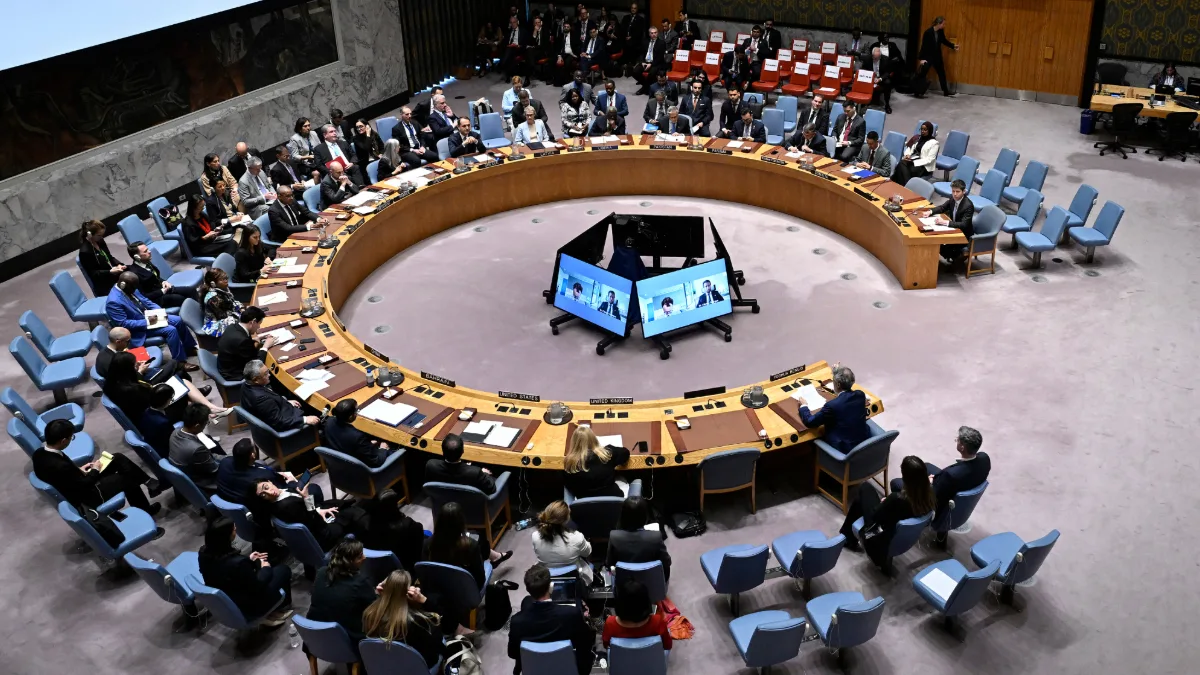
As policymakers in Washington and Brussels grapple with how to constrain cutting-edge AI development, a starkly different conversation unfolded at the United Nations General Assembly High-Level Week. Nations across Africa, Asia and Latin America pushed back against the Western regulatory consensus, calling instead for expanded access to AI capabilities and a voice in setting global rules. The tension crystallized around a single concern: that efforts to slow AI progress could entrench existing technological inequalities rather than remedy them.
Pakistan crystallized the anxiety in blunt terms. Deputy Prime Minister Mohammad Ishaq Dar acknowledged the case for pacing frontier AI development but added a sharp caveat: "Pacing must not become a new form of gatekeeping." This refrain echoed across the General Assembly floor, as countries warned that safety-first approaches could become tools for the already-powerful to lock in their advantages.
The Case for Inclusion
Turkey's President Recep Tayyip Erdoğan called for a UN convention to establish "a common international legal framework for AI," urging faster movement toward a UN International Convention on Artificial Intelligence. South Korea proposed a "Global AI Universal Basic Society" as part of its K-Initiative, framing AI access as a matter of social welfare alongside healthcare, pensions and housing. The country also pitched a Global AI Hub to ensure "no country or individual is excluded from the fundamental benefits of AI."
Barbados Prime Minister Mia Mottley articulated the principle underlying these calls: AI is "a technology that will affect every State" and therefore "must be governed by rules that every State has had the opportunity to shape." The Democratic Republic of Congo's Prime Minister Judith Suminwa Tuluka warned that "the digital divide cannot become an intelligence divide," linking AI infrastructure to the continent's critical-mineral resources, particularly cobalt.
South Africa's Minister of International Relations and Cooperation Ronald Lamola made the same connection explicit: "Africa must have a stake in shaping the rules that govern the development and deployment of Artificial Intelligence." Bangladesh Prime Minister Tarique Rahman called for technology transfer, skills development and affordable access to modern technologies for developing countries, framing the issue as a matter of preventing "today's digital divide" from becoming "tomorrow's artificial intelligence divide."
Divergent Visions on Risk and Innovation
Nigeria's Vice President Kashim Shettima, speaking on behalf of President Bola Tinubu, rejected what he characterized as an overly cautious stance. "We refuse to surrender our technological future to paranoia," he said, acknowledging that AI could be weaponized but emphasizing its potential to "transform healthcare, education, agriculture, governance and economic productivity."
India's External Affairs Minister S. Jaishankar articulated a vision centered on national sovereignty. "We believe in the right of each nation to shape its ecosystem with the development of its own models and deployment strategies consistent with its national goals and priorities," he said, adding that "AI will be very much part of our partnership agenda with the global South."
Argentina took the argument further, opposing what it saw as preemptive regulation. President Javier Milei argued that giving governments control over AI innovation meant "granting some people … the power to limit what everyone else can create." Argentina's preferred approach would include "the commitment to not regulate preemptively, limited liability for companies operating with AI agents and tax incentives."
Japan's Institutional Approach
Japan's Prime Minister Takaichi Sanae pointed to existing multilateral frameworks rather than calling for new ones. She highlighted the Hiroshima AI Process, which Japan launched with other governments to develop international principles and a code of conduct for generative AI. She also announced Japan's intention to host an AI Summit "at the earliest opportunity."
Emerging Institutional Landscape
Several initiatives emerged from the General Assembly week to shape the coming months of AI governance debate:
- Finland and Norway launched a "Call for Control of Frontier AI Models" on September 21, calling for pre-deployment testing, independent evaluation and common standards. The Norwegian government reported that 22 leaders backed the appeal at launch.
- The Partners for Multilateralism (P4M) Declaration, a multilateralism and UN reform declaration co-signed by the EU, Kenya, Australia, Barbados, Canada, Brazil and India, was adopted.
- Barbados will host the second in-person meeting of the UN Independent International Scientific Panel on AI in November 2026.
- The UK will place AI at the center of its G20 presidency next year, according to Prime Minister Andy Burnham, seeking a single set of global principles and standards.
- Switzerland announced a Geneva AI Summit for June 21–22, 2027 at Palexpo, themed "Bridging Innovation and Trust."
- A second UN Global Dialogue on AI Governance is scheduled for New York on May 3–4, 2027.