A decade of work in the global fact-checking movement — first as a founder, then serving four years as director of the International Fact-Checking Network (IFCN) before joining Logically — taught me that the original vision was straightforward: assemble an annually audited global network of fact-checkers to counter false narratives. For several years, this strategy succeeded. Membership expanded, tech companies backed the initiative, and fact-checks became woven into public conversation.
Two watershed moments changed everything: the COVID-19 crisis and the 2020 US presidential race thrust fact-checking into mainstream consciousness among politicians, journalists, scholars, and the general public. Suddenly, the work gained prominence — but also backlash. Harassment of fact-checkers intensified, and powerful voices began framing the work as suppression rather than journalism, a narrative that proved both convenient and lucrative.
Meta and other platforms, to their credit, expanded spending on integrity measures and publicly highlighted partnerships with professional fact-checking groups. They targeted high-stakes moments: elections, military conflicts, natural disasters, civil unrest, and schemes designed purely for profit. These challenges, though sometimes dismissed as secondary concerns, mattered enormously to hundreds of millions navigating an internet saturated with deception and harmful falsehoods.
Yet the misinformation threat has accelerated while the defences against it have stalled. Academic research confirms fact-checking's value while exposing its shortcomings in velocity and reach. The debate has shifted: no one seriously questions whether fact-checking should exist, but rather how it must transform — and whether a new generation of solutions can achieve scale, harness technology, and sustain itself financially without depending on platform charity.
New Strategy: Wisdom of the Crowds
Meta's announcement that it will terminate its third-party fact-checking programme, beginning in the United States, signals a fundamental recalibration in how the industry tackles misinformation. The shift reflects a sector-wide preference: outsourcing verification to user-generated solutions rather than bankrolling independent, rigorous fact-checkers. Platforms are gravitating toward cheaper, more scalable options that transfer responsibility from trained professionals to ordinary users.
X's expansion of Community Notes exemplifies this trend. Though the mechanism has delivered results in isolated instances, it cannot fully substitute for expert verification. Crowdsourced corrections depend on consensus-building, which means accurate information may struggle to gain visibility if it clashes with prevailing opinion or faces coordinated suppression. Such vulnerability demands robust protections against organized disinformation.
The underlying shift is unmistakable: platforms are transferring fact-checking authority from credentialed specialists to user preference. While proponents frame this as democratizing truth assessment, it amounts to institutional retreat. When public health, electoral legitimacy, and national security hang in the balance, verification cannot rest on popularity metrics or amateur judgment. Community input can enrich discourse, but diversity of opinion does not substitute for the competence required to evaluate factual claims.
Why Current Fact-Checking Models No Longer Work
When the IFCN launched roughly a decade ago, fact-checking remained rooted in journalism: newsrooms exposed viral falsehoods, and platform partnerships amplified corrections. The misinformation landscape has transformed radically. Speed has multiplied, algorithms drive spread, AI generates content at volume, disinformation networks operate with sophistication, and virality mechanics dominate. The original fact-checking architecture, designed for slower cycles, cannot match the velocity of contemporary manipulation.
The IFCN built credibility through adherence to a code of principles, guaranteeing that member organizations maintained exacting standards. Yet the system depends on labour-intensive, slow procedures — conceived for an era when hoaxes propagated story by story, not at the speed of machine learning.
Money remains a persistent obstacle. Most fact-checking outfits survive on grants and temporary platform deals — a precarious arrangement that collapses without regulatory pressure forcing tech companies to shoulder costs. Meta's withdrawal from its fact-checking partnerships illustrates the danger of betting on corporate funding and distribution channels. The uncomfortable truth: professional fact-checking cannot expand to necessary proportions without technological transformation.
The Path Forward: A Scalable Fact-Checking Model
The solution demands moving beyond scattered, manual-heavy operations toward an AI-augmented, platform-embedded architecture that functions across multiple services. Rather than depending on after-the-fact corrections, we require a layered system where artificial intelligence, platforms, professional fact-checkers, and community participants collaborate to validate information rapidly and widely, prioritizing severity and spread.
A technology-forward approach to fact-checking should anchor itself in assessing danger and viral potential, intervening at the appropriate moment:
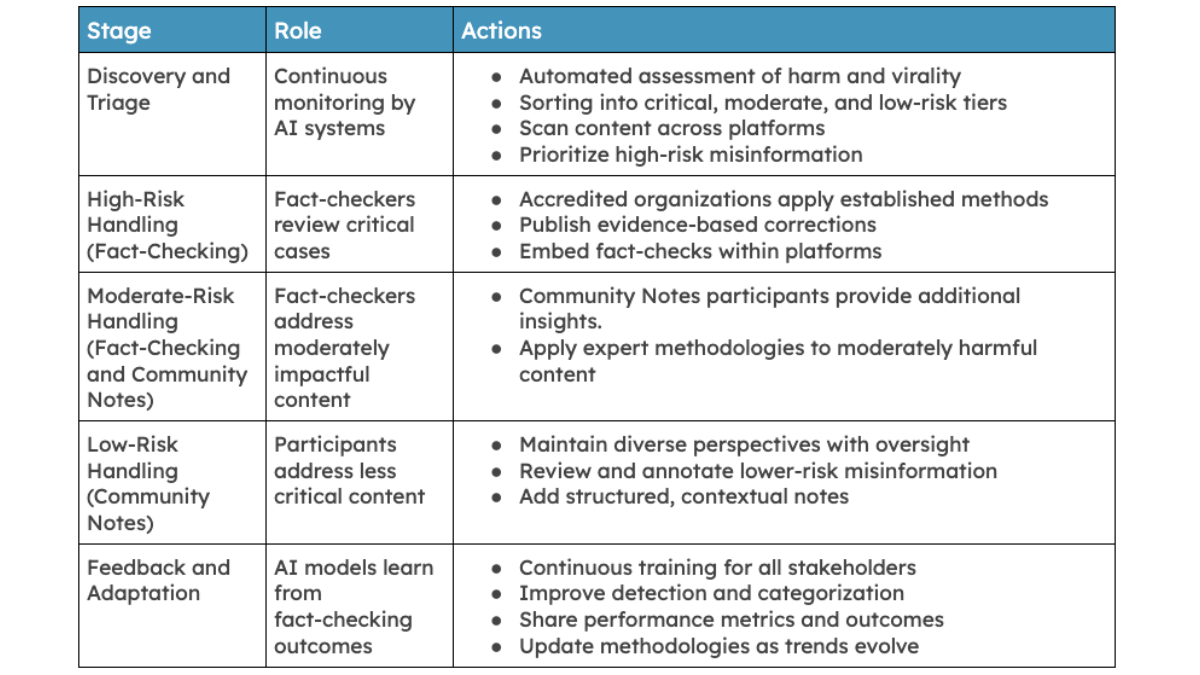
- AI-driven prioritization & triage: Automated systems flag misinformation according to harm potential and propagation speed, enabling credentialed specialists to act before falsehoods take root. Emerging claims can be classified by risk tier, guaranteeing that high-consequence statements receive expert scrutiny, while minor falsehoods flow through scalable community mechanisms.
- Hybrid verification model: A stratified framework combining professional verification, machine learning, and structured community participation — sidestepping the dangers of unmoderated crowdsourcing while enabling proportionate, multi-layered responses.
- Integrated, contextual fact-checking: Corrections must transcend standalone articles, appearing directly in feeds, search engines, and conversational platforms. This positions corrections where they matter most, eliminating friction and meeting users at the point of misinformation.
- Long-tail moderation via Community Notes: While credentialed experts handle high-stakes falsehoods, community-driven tools like Community Notes manage lower-stakes, niche misinformation — building a durable, expandable verification system.
Who Needs to Step Up?
- To Platforms: Verification remains vital, yet requires reimagining for velocity, integration, and technological sophistication. Build smarter tools instead of abandoning the mission.
- To Fact-Checkers: The original IFCN framework no longer suffices. Survival in the misinformation fight demands adopting AI, algorithmic tools, and platform collaboration.
- To Policymakers: Regulations addressing false information must reward platforms for deploying scalable, evidence-based solutions — not merely mandate removal policies that ignore nuance.
- To Investors: Trust and safety markets are expanding, and verification technology represents an unexploited commercial frontier. Fact-checking serves the public interest and opens business avenues for platforms, enterprises, and intelligence vendors.
The Future of Fact-Checking Is Ours to Build
Ten years back, fact-checking offered a response to an emerging crisis. Today's threat demands a different answer — one that is scalable, self-sustaining, and technologically advanced. The real question is not whether fact-checking survives, but whether we possess the will to construct something adequate to the scale of digital misinformation today.
The moment to shape fact-checking's trajectory is now. We must think ambitiously, move decisively, and construct a future where fact-checking does not hinge on any single platform's benevolence. Meta wields enormous influence online, but it neither built the internet nor can its retreat solve the misinformation epidemic. Solving this requires a cross-platform remedy, one liberated from the whims of technology corporations. Rather than waiting for platforms to resume support, the fact-checking community must seize the initiative and establish an independent, powerful system that compels their engagement. Building collective leverage over these companies is paramount — meaningful change arrives only when we exert pressure and insist on stronger action.
Source: Tech Policy Press