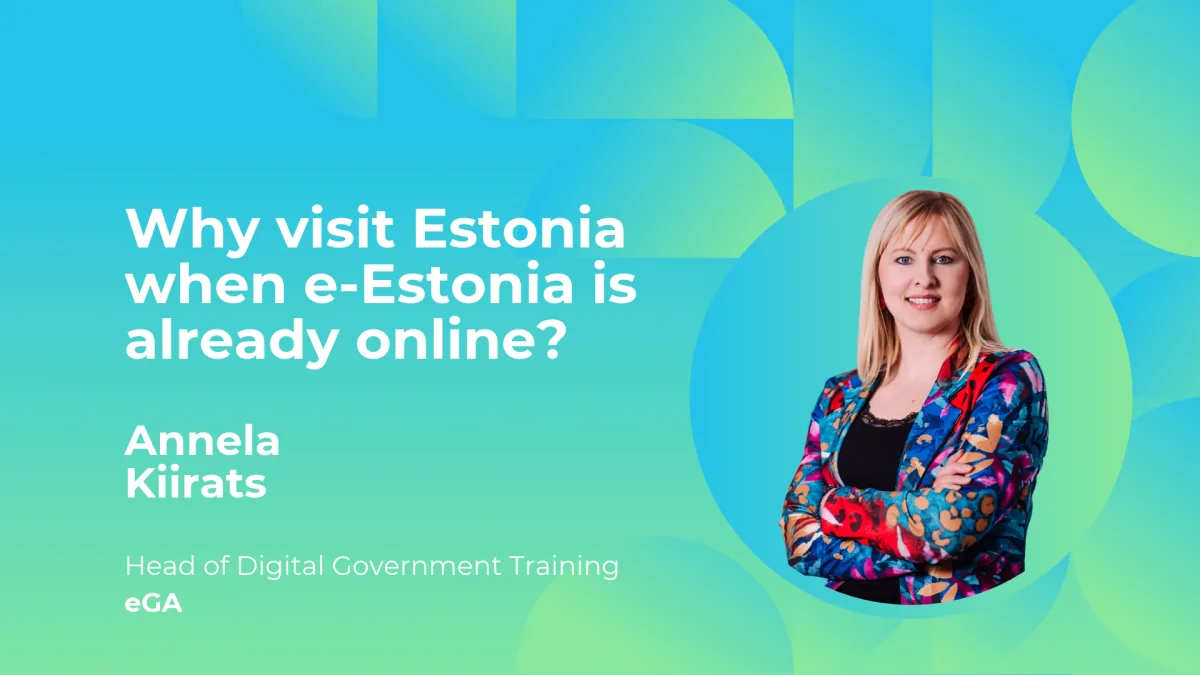
Digital identity systems, X-Road infrastructure, interoperability frameworks and public service delivery—all of these topics about Estonia's digital transformation are readily accessible through online channels. Webinars, e-learning courses and AI tools can walk you through how Estonia constructed its digital society. Yet Annela Kiirats, Head of Digital Government Training at the e-Governance Academy, argues that understanding Estonia's achievements requires more than consuming content from a screen. Grasping what Estonia has accomplished differs fundamentally from comprehending the reasoning and mechanics that make it function.
Observing the ecosystem and the people who built it
Visitors frequently arrive in Estonia anticipating encounters with cutting-edge technological systems. Instead, they encounter something far more instructive: a digital government architecture assembled across multiple decades—an intangible reality that visitors sense rather than observe directly.
Functioning digital identity, secure information transfer between government registers, trustworthy data quality, regulatory frameworks, data protection measures and citizen-facing services must operate in concert. Underpinning these technical components are governmental bodies and individuals who have cultivated collaborative relationships, navigated complex trade-offs, and recalibrated their approaches when initial strategies proved ineffective. This capacity for operational flexibility and learning from setbacks has been essential to their progress.
An in-person study visit permits observation of these interdependencies. Equally significant, it provides direct engagement with the individuals responsible for these systems—specialists with firsthand experience in the process.
Dialogue with someone who has invested years in constructing a nationwide identity infrastructure, establishing data interoperability, or reimagining government services transcends what appears in official documentation or presentation slides. Practitioners can address questions such as: "What prompted this particular decision?" What obstacles proved most difficult? Through what mechanisms did you persuade different agencies to work together? What initiatives did not succeed? What would you approach differently in hindsight? Which choices are essential for long-term viability? What prevents innovation from diminishing? According to Kiirats, these inquiries represent some of the most valuable exchanges in government modernization efforts.
Occasionally, the most illuminating moments emerge unexpectedly—perhaps during informal conversation, when one inquiry prompts another, and a visiting official suddenly perceives their own institutional challenge in a fresh light. This occurs because participants have temporarily stepped away from routine administrative responsibilities and concentrated on the experiences that produced Estonia's thriving digital infrastructure.
A reference point, not a template
For Estonians, a digitally integrated society represents everyday reality. Implementation varies across different domains, yet the infrastructure remains universally accessible—available whenever citizens choose to utilize it. Kiirats emphasizes, however, that other nations ought to resist straightforward replication of Estonia's model. Each country operates within distinct institutional frameworks, legal systems, financial constraints, societal norms, and stages of technological advancement. Solutions developed in Estonia cannot be transplanted wholesale and expected to function identically elsewhere. The underlying philosophy, however, warrants universal adoption: comprehending what digital transformation entails, recognizing the significance of innovation, valuing open dialogue, and fostering genuine partnership.
This principle underscores the significance of study visits. The objective is not to depart with an inventory of Estonian technologies, since artificial intelligence can generate such lists effortlessly. Rather, the goal involves internalizing the rationale, choices, and experiences embedded within these systems, then asking: "Which elements could succeed in our specific circumstances? What aspects spark sufficient interest to motivate us to develop our own solutions, tailored to our distinctive requirements?"
Estonia's accomplishments offer valuable lessons. The nation's missteps and accumulated wisdom can prove equally instructive, potentially steering others away from costly mistakes. Though digital transformation operates through technological channels, the acquisition of knowledge remains fundamentally rooted in human connection.
Learning remains human
Administrations are making consequential determinations regarding artificial intelligence deployment, information management, identity verification, information security, and government service provision—decisions whose effects will reverberate throughout their nations for decades. Gaining perspective from those who have previously navigated comparable decisions can conserve resources, reduce expenditure, and prevent costly errors.
One training participant captured this sentiment: "Training is expensive, but not getting trained is more expensive," and another reflected: "I have heard about e-Estonia, but I always took the position that our realms are too far from one another, until I actually participated in the week-long course and had a chance to discuss possible scenarios for us. That totally changed my point of view."
Throughout her years facilitating delegations to Estonia, Kiirats observes a consistent pattern: the most impactful study visits do not furnish predetermined solutions. Instead, they cultivate more incisive inquiries and facilitate more deliberate decision-making.
Should your institution or administration be charting its trajectory in digital modernization, travel to Estonia bearing a specific problem you seek to address. If you have not yet crystallized your particular challenge, the e-Governance Academy team can assist in defining one. Arrive prepared for substantive conversation, equipped to evaluate how international experiences might translate into your local context. Engage directly with the specialists. Pose the challenging questions. Assess your current position and formulate aspirations for tomorrow. Kiirats guarantees that you will encounter perspectives you had not previously contemplated. What constitutes routine practice in one setting frequently represents breakthrough innovation elsewhere. Through such exchange, understanding advances.