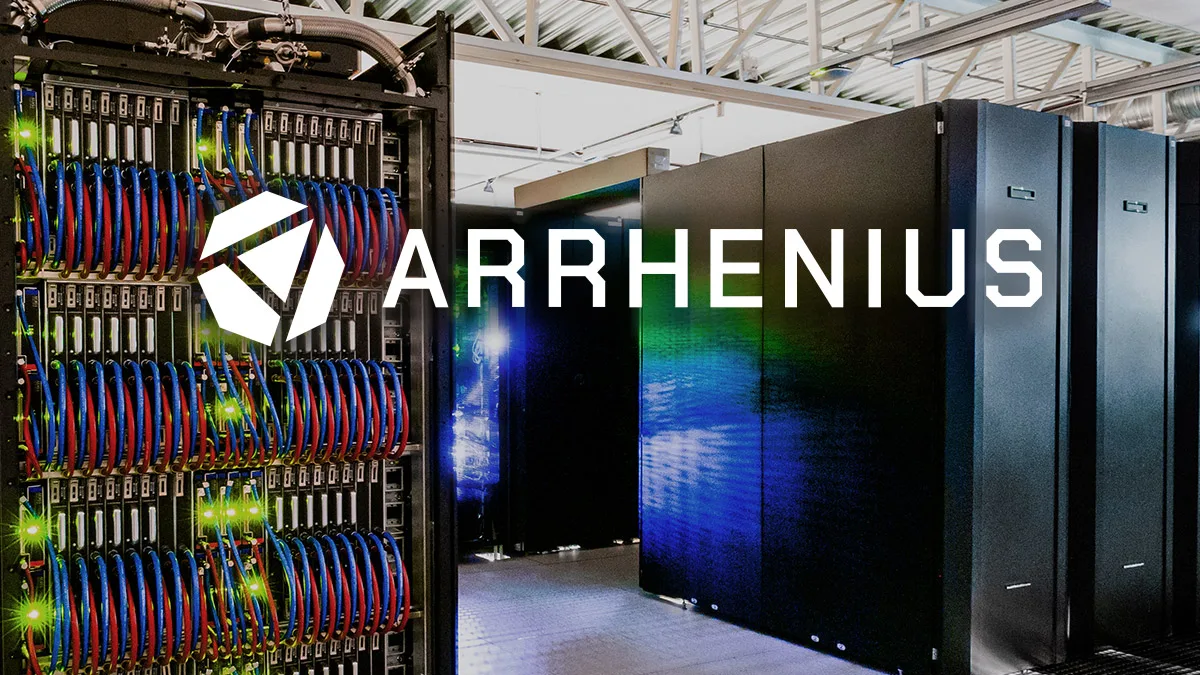
A ribbon-cutting ceremony at Linköping University marked the official opening of Arrhenius, a new mid-range supercomputer operated jointly by the EuroHPC Joint Undertaking and NAISS. The event brought together Anders Dam Jensen, Executive Director of EuroHPC JU, and Maria Nilsson, State Secretary to the Minister for Upper Secondary School, Higher Education and Research.
With the inauguration of Arrhenius, I am delighted to welcome a new mid-range supercomputer to our EuroHPC portfolio of HPC systems, marking another step towards enhanced European technological sovereignty. Arrhenius' ability to carry out highly demanding computational tasks will allow our users to push boundaries in scientific and technological simulations, helping to drive breakthroughs in areas like drug discovery and climate change mitigation.
Anders Dam Jensen, EuroHPC JU Executive Director
About the Arrhenius Supercomputer
Arrhenius delivers computational performance exceeding 60 petaflops—more than 60 million billion operations per second. The machine achieved 42nd place on the June 2026 TOP500 ranking of the world's most powerful supercomputers. Its architecture supports intricate simulations and compute-heavy artificial intelligence workloads across climate modelling, materials science, life sciences, and engineering disciplines.
The system serves researchers, commercial enterprises, and public institutions across Europe. Its robust security and data protection features make it well-suited for proprietary industrial development and confidential research involving personal information.
Energy performance represents a key strength: Arrhenius achieves more than 61 billion operations per watt, securing 24th position on the Green500 list. This efficiency aligns with EuroHPC JU's commitment to procuring environmentally responsible supercomputing infrastructure.
Researchers have already begun accessing Arrhenius through the EuroHPC AI for science access call prior to the formal inauguration. The machine is now open to broader user communities via the EuroHPC regular access call, benchmark mode, and development mode.
More details
The supercomputer takes its name from Carl Axel Arrhenius, a Swedish geologist and chemist who identified the mineral gadolinite in 1787, a discovery that later revealed the presence of rare earth elements.
HPE supplied the system under a contract executed by EuroHPC JU in July 2025. The total project value reaches EUR 68.5 million, with EuroHPC JU providing up to 35% of funding through the Digital Europe Programme, supplemented by contributions from the Swedish Research Council to NAISS.
EuroHPC JU and NAISS, which operates from Linköping University, share management of access to the supercomputer's resources proportionally to their respective investments. RISE (Research Institutes of Sweden) and ENCCS (the EuroCC National Competence Center Sweden) participate in efforts to expand uptake among industrial and public sector organisations.
Background
EuroHPC JU functions as a legal and funding mechanism that unites the European Union with participating member states to coordinate supercomputing efforts and consolidate resources, positioning Europe as a global supercomputing leader.
The organisation has already acquired 12 supercomputers distributed throughout Europe to establish world-leading computational infrastructure. Scientists, public sector organisations, and industrial users across Europe can access these systems through EuroHPC Access Calls to support scientific progress and develop applications with industrial, scientific, and societal value.
EuroHPC JU currently oversees 19 AI Factories across Europe, complemented by 13 AI Factory Antennas offering complimentary, tailored assistance to small and medium enterprises and startups. Sweden's AI Factory, previously called the Mimer AI Factory, will operate a mid-range AI-focused supercomputer emphasising cloud-based access and extensive storage for confidential data. The facility will build expertise and training in life sciences and healthcare, material sciences, autonomous systems, and gaming—sectors where Europe and Sweden hold particular competitive advantages.
The EuroHPC JU is also deploying a European Quantum Computing infrastructure that combines various European quantum technologies with operational supercomputers.
Investment in research and innovation projects supports the development of a comprehensive European supercomputing value chain, encompassing processors, software, applications, and the expertise necessary to build strong European HPC capabilities.
Council Regulation (EU) 2026/150, recently adopted, has broadened EuroHPC JU's mandate to include new action areas focused on deploying AI Gigafactories throughout Europe and advancing quantum technology development.