Mounting resistance to data center projects throughout the country has prompted the tech industry to adopt a familiar strategy: deploying the same tactics that other heavily regulated sectors have used to circumvent public scrutiny and accountability. These efforts expose significant gaps in U.S. transparency and oversight mechanisms, even as the industry channels hundreds of billions in capital toward facility construction at unprecedented speed.
Manipulating public perception through hidden operations is hardly new. The utility sector has deployed AI-driven influence campaigns, while the oil industry created fraudulent recycling organizations to evade accountability for plastic waste. These schemes typically operate behind polished corporate branding, effectively shielding company profits from regulatory pressure and public accountability.
In some affected areas, residents describe feeling like combatants against both corporate interests and their own elected representatives. During the Midwest Data Center Investment Conference and Expo (DICE) in Chicago in September 2025, Kevin Nichols, working with the advocacy organization Earth Charter Indiana, heard a speaker compare promoting data centers to counter-insurgency operations from military service in Iraq and Afghanistan, including tactics such as "going undercover in bars and churches to gauge a community's potential for resistance to a data center development."
Intelligence-gathering language appears in recruitment materials from Data Center Watch, which monitors deals "blocked or delayed" by local opposition. The organization seeks applicants to "conduct open-source and targeted research in various sources, including social media" to identify "political risks emerging from local opposition to data centers." A Data Center Watch representative noted the group "does not maintain separate HR or recruiting functions" from 10a Labs, which describes itself as collecting "intelligence" for "AI unicorns, Fortune 10 companies, and US tech leaders."
Money and Influence Operations
The technology sector is investing heavily to shape public discourse. Ahead of the 2026 U.S. midterm elections, AI-focused super PACs have already spent more than $50 million on Congressional races. According to Transformer News, the largest portion flows through Leading the Future, whose principal donors include venture capitalist Marc Andreessen, his partner Ben Horowitz, and OpenAI President Greg Brockman and his wife, Anna.
Leading the Future and its affiliated group Build American AI have moved beyond campaign contributions. In May, Taylor Lorenz reported for Wired that Build American AI enlisted social media influencers in a pro-data-center push centered on competition with China. One month later, Lorenz and Tyler Johnston of Model Republic released an investigation alleging Build American AI operates multiple fake "sockpuppet" accounts on X. That same month, Johnston found that Think Big, another Leading the Future-affiliated PAC, receives substantial social media engagement from what appear to be counterfeit accounts posing as OnlyFans performers.
Johnston's earlier reporting suggested Leading the Future may be connected to Acutus, an apparent AI-generated news outlet that echoes Leading the Future messaging and regularly publishes attacks on AI safety advocates. In March, Transformer revealed that Build American AI spent more than half a million dollars on ads designed to harvest contact details from between 500,000 and 1,000,000 social media users—a classic astroturf technique that inflates perceived support levels regardless of actual grassroots backing.
Front Groups and Nonprofit Facades
A significant trend involves the data center industry establishing nonprofit front organizations. Many of these registered nonprofits deliberately obscure their funding sources, staff composition, and corporate ties. While IRS Form 990 filings can sometimes expose these relationships, their websites typically withhold basic details about leadership and financial support.
"Companies' use of third parties like corporate front groups and astroturf campaigns to secretly advance their interests has a long tradition in the US," said Jocelyn Leitzinger, a researcher studying activist campaigns and corporate responses. "Over the past century, companies in highly regulated industries such as tobacco, fossil fuels, and pharmaceuticals have used corporate front groups to block or rollback regulations protecting consumers and the natural environment."
Virginia Connects spent approximately $700,000 during fiscal year 2024 on mailers, text messages, and community outreach promoting data center development to Virginia residents. According to its Form 990, the organization is based in Richmond and connected to the Data Center Coalition, an industry lobbying organization; Josh Levi, who leads the Coalition, also serves as Virginia Connects' principal officer.
The Texas Tribune reported in May that Texas Connects, a nonprofit "dedicated to educating Texans about the data center industry," was similarly established by the Data Center Coalition. Comparable organizations—Indiana Connects, Pennsylvania Connects, Connected Ohio, Connected Georgia, and Oregon Connects—have recently surfaced with nearly identical website designs, all linked by the same Google Ads ID.
In a statement to Tech Policy Press, Data Center Coalition president Josh Levi said that America Connects, the umbrella organization for these similarly branded groups, "represents a coalition of stakeholders from the data center ecosystem working to educate and engage with communities about the benefits of data centers. The initiative initially launched in Virginia in 2024 and is expanding its education efforts into Texas, Ohio, Pennsylvania, Indiana, Oregon and other additional states."
Other industry participants pursue comparable tactics. In Virginia's Fauquier County, Fauquier Forward promotes data center development as a revenue-raising mechanism. The Fauquier Times reported in October that the contact person listed on Fauquier Forward's Facebook page is the co-founder of Gigaland, a data center development company. The group maintains an active social media presence, including dozens of TikTok videos, though engagement has been minimal.
In Missouri, KSDK News reported in February that an organization called Missourians for Data and Technology Advancement, or MODATA, published an advertisement quoting the Jefferson County Executive—who denied any connection to the group. The ad was purchased by Axiom Strategies, an out-of-state public relations firm. A 2025 press release describes MODATA as a "new statewide coalition," yet the organization's website does not identify its members.
A MODATA spokesman told Tech Policy Press that "MODATA represents a broad coalition of large and small businesses, organizations, utilities, labor organizations, and developers in Missouri that support responsible data center policies in the state. We track the positive comments from elected officials and experts on our website as well and amplify those through paid and earned media."
The actual impact of these organizations remains uncertain. Chloe Humbert, an activist in Scranton who has encountered Pennsylvania Connects advertisements, expressed doubt. In a statement to Tech Policy Press, she said, "I have no idea who PA Connects' ads would even influence. Maybe the politicians?"
Evidence suggests Humbert may be correct. Data center advocates are increasingly shifting toward strategies that distance the public while cultivating relationships with local officials.
Controlling the Narrative Locally
Project Jupiter, a hyperscale data center being developed by OpenAI and Oracle in Doña Ana County, New Mexico, illustrates these evolving tactics. Daisy Maldonado, a Doña Ana County Commission candidate, first learned of the project from someone claiming to be a community organizer who actually worked for BorderPlex Digital Assets, one of the development companies. Maldonado said the individual "[recruit[ed] people to speak" positively about the initiative. Others reported he participated in County Commission meetings without disclosing his BorderPlex employment. (BorderPlex Digital Assets did not respond to a request for comment.)
According to Maldonado, Project Jupiter's approach evolved over time. Public engagement shifted from open hearings to community forums offering corporate officials greater control over proceedings. Before a county commission vote on bond issuance, corporate and county representatives organized five community forums.
"People were incredibly unhappy," Maldonado said of the meetings. Security and law enforcement attended a contentious session with standing-room-only attendance; at the subsequent forum, Maldonado reported, attendees were instructed to submit questions on note cards. Following objections, organizers resumed calling on audience members, though community members suspected some participants could be industry representatives.
On September 19, 2025, Doña Ana County voted to issue bonds following an all-day meeting with a packed audience and extensive public testimony.
The forum-management approach Maldonado described extends beyond New Mexico. In Texas, former State Senate candidate Rena Schroeder observed comparable dynamics in "meet-and-greets" that proved unproductive: "You go in thinking maybe you could say something, or you know, get some information, but you can't," she said.
Representation and Appropriation
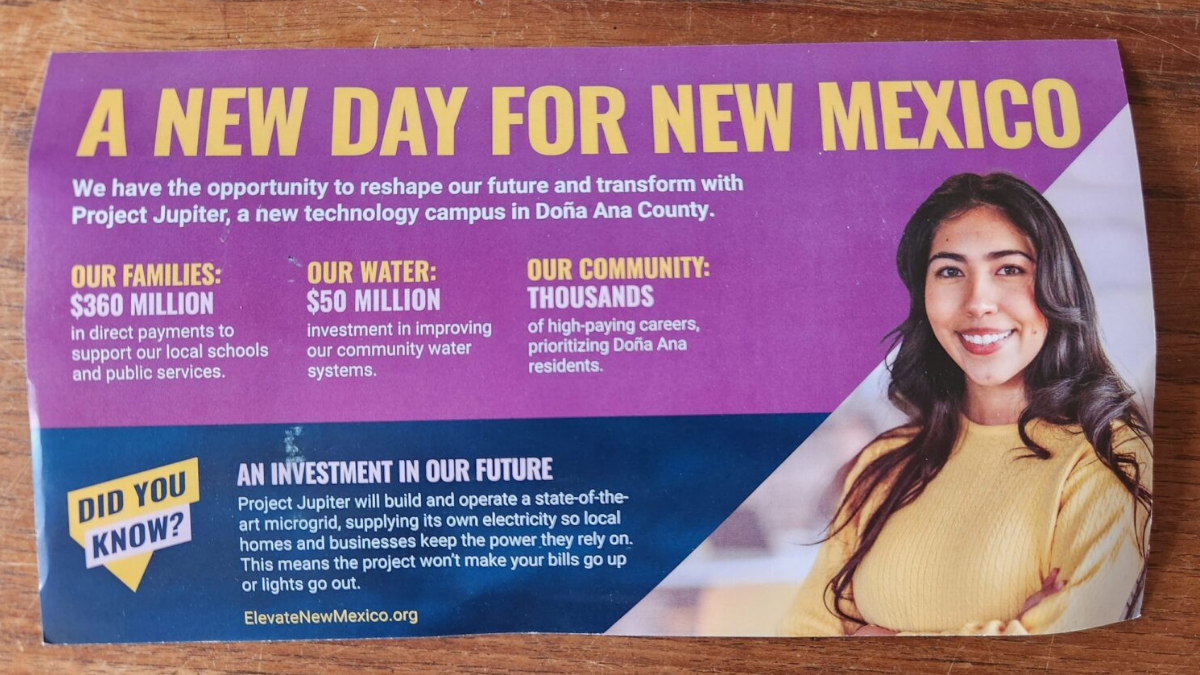
Source New Mexico reported in March that Elevate New Mexico ran a campaign promoting Project Jupiter through mailers and digital advertising. One mailer featured a smiling young woman with dark hair and brown skin alongside the text "A new day for New Mexico."
Source New Mexico discovered the woman is a stock model and that Elevate New Mexico's mailing address is in Alexandria, Virginia. Critics characterized this as "brownwashing," a practice where companies appropriate the identities of people of color. Project-involved companies established LLCs with names including "Green Chile Ventures" and "Acoma"—the latter being a Native American tribe's name. Following criticism from that tribe's governor, Acoma LLC renamed itself Yucca Growth Infrastructure; YUCCA also serves as the acronym for Youth United for Climate Crisis Action, a New Mexican environmental organization.
In April, the New Mexico State Ethics Commission sued Elevate New Mexico, arguing the organization should register as a state lobbyist. Both Source New Mexico's reporting and the lawsuit indicate that APCO Worldwide, a public affairs firm promoting data center advisory services, funded at least some of Elevate New Mexico's digital advertisements.
Glenn Wikle, a Santa Fe environmental activist with Third Act Actions Lab, a nonprofit network of volunteer working groups, told Tech Policy Press that "APCO has an extraordinary rap sheet when it comes to astroturfing." Linda Edwards, also from Third Act Action Lab, noted that APCO's previous work includes the Advancement of Sound Science Coalition, an innocuously named initiative created with Philip Morris in 1993 to undermine research on secondhand smoke dangers. "If you go to APCO worldwide's site, they present themselves as a PR firm that can enhance your reputation. Companies like Philip Morris turn to them for a reason," Edwards said. (APCO did not respond to a request for comment from Tech Policy Press.)
The Revenue Squeeze
Communities opposing data center development confront the cumulative impact of tax reforms that have depleted local government funding. The Missouri Municipal League's policy statement notes, "In many of Missouri's municipalities, annual revenues are never adequate to meet the service needs and demands of citizens." Missouri's Senate Bill 3, which required a majority of counties to place property tax freezes and caps before voters last April, is expected to worsen the situation.
Local officials frequently invoke revenue requirements when defending data center projects to skeptical constituents. Tiffanie Arthur, a candidate for Indiana State Representative in District 63, told Tech Policy Press that before a data center was rejected by the Washington city council, officials posed the question: "Do you want us to cut the fire department? Do you want us to cut the police department? Which one of these things do you want us to cut, because we don't have the money."
In Montgomery County, Missouri, where Google's 2024 $15 billion data center initiative generated substantial backlash and a Sunshine Law lawsuit from rural residents, county leadership emphasized the project's effect on their operating budget and local public health services facing financial constraints.
Tech industry coalitions recognize data centers' appeal as a municipal financial solution. When the proposed Gateway Digital Campus in Franklin County, Missouri, encountered intense, organized opposition from rural residents, MODATA promised "$50 million in… direct funding for Franklin County schools, police, fire departments, and parks."
NetChoice, a Washington, D.C.-based trade association with core members and funders including AWS, Google, Meta, TikTok, and X, countered local opposition to Amazon's $10 billion data center project in Montgomery County, Missouri by contending that data centers function as responsible corporate entities "paying local property taxes that fund schools, repair roads and bolster emergency services while easing the burden on everyday homeowners." The Meta-linked dark money organization American Edge has intensified messaging framing data centers as essential fiscal resources. In policy briefs addressing Calvert County, Maryland and rural jurisdictions nationwide, American Edge cites federal and state funding reductions to argue that conventional local tax bases cannot sustain schools, roads, or public safety. American Edge CEO Doug Kelly summarized the industry position by stating that leaders "should not hastily slam the door shut on the biggest economic opportunity to reach them in a generation."
A different strategy is emerging in Missouri, where an advertisement attempts to harness anti-data center sentiment to produce conditions more favorable for corporate investment. The ad urges voters to "make big tech pay so you don't have to" by supporting Amendment 5. The ad's claims have been disputed, and its source remains unclear. Financial disclosures show that earlier this year, a PAC committee called Missouri Promise received a $1.9 million cash transfer from Missouri Promise Inc., a Delaware-based nonprofit corporation, to finance Amendment 5 advertising. Beyond that point, according to a ProPublica investigation, the funding trail disappears.
Amendment 5, scheduled for the August 2026 ballot, does more than reduce taxes; it would fundamentally restructure public finance by substituting sales taxes for income taxes, thereby increasing local government reliance on revenue sources such as hyperscale data centers.
Indiana's 2026 policy statement from Accelerate Indiana Municipalities—representing more than 500 of the state's cities and towns—highlights the "strict revenue controls" local governments have faced for decades. The group identifies "...a reluctance to allow locals to have the authority to institute other types of taxes to offset the loss from the property tax caps," and notes that "despite growing demands from the federal and state levels of government and taxpayers for improved services, the state has restricted local government levy growth."
Indiana's Senate Enrolled Act 1 has intensified financial pressure on municipal and school budgets. In St. Joseph County, where grassroots opposition emerged over AWS data center development, Bill Schalliol, the county's Executive Director of Economic Development, pointed to a negotiated side agreement explicitly designed to fund local emergency and municipal services, telling Inside Indiana Business, "It'll help parks. It'll help fire departments in the area, it will allow money for road improvements."
Corporate Shields Against Accountability
Once data center deals materialize, corporate organizations like the Consumer Energy Alliance (CEA) intervene to protect tech companies from regulatory oversight. The Energy and Policy Institute, a nonprofit watchdog, reports that CEA markets itself as "the voice of the energy consumer" while receiving funding from energy monopolies and operating through a private public relations firm. In Connecticut, CEA has served as a crucial political protector for the data center sector. By reframing corporate tax preservation and grid-intensive infrastructure as beneficial for "working families," as it did in official testimony to the Connecticut General Assembly in February, the group attempts to neutralize authentic grassroots opposition. During spring 2026, CEA expanded efforts centered on data center development in Missouri and Indiana.
Democratic Breakdown
As communities nationwide grapple with rapid data center expansion and struggle to participate meaningfully in democratic processes, they characterize their situation as a David versus Goliath confrontation with corporate power. Janice Bacon, from the Indiana organization Protect Morgan County, told Tech Policy Press, "Everybody's always like, 'well why is our back pushed up against the wall? We have no recourse.' People are just now realizing that laws have been written to cut the constituency out."
Arthur told Tech Policy Press that opposition to data center development transcends partisan lines. "People are waking up to the fact that it's not about right vs left but have's and have not's. They're seeing, 'It's not my neighbor that is ruining my quality of life, it's billionaires who want more and more and more and have no concern about my quality of life,'" she said.
Opposition can reach substantial levels. In Henry County, Indiana, Commissioner Steve Dellinger publicly claimed that most constituents backed local data center development. However, documents obtained by the community group No Henry County Data Center showed that over 80% of communications he received urged him to vote against it, a figure corroborated by County Commissioner Susan Huhn. Despite this overwhelming constituent opposition, Dellinger and Commissioner Joe Wiley voted to approve rezoning for the data center, with Huhn dissenting.
Local frustration is intensifying. Kiley Blalock, co-founder of No Henry County Data Center, said, "I know we're a constitutional Republic and the point is to uphold democracy. But it sure doesn't feel like democracy at this point… It's not so much leaning towards 'what do the people want?' but 'what do these corporations want?'"
Festus, Missouri is advancing data center development despite significant public opposition, a decisive municipal election that removed four pro-project city council members, an active transparency lawsuit, and a successful citizen-led petition drive that certified a recall election for the mayor and remaining officials—though they ultimately blocked it from reaching the ballot.
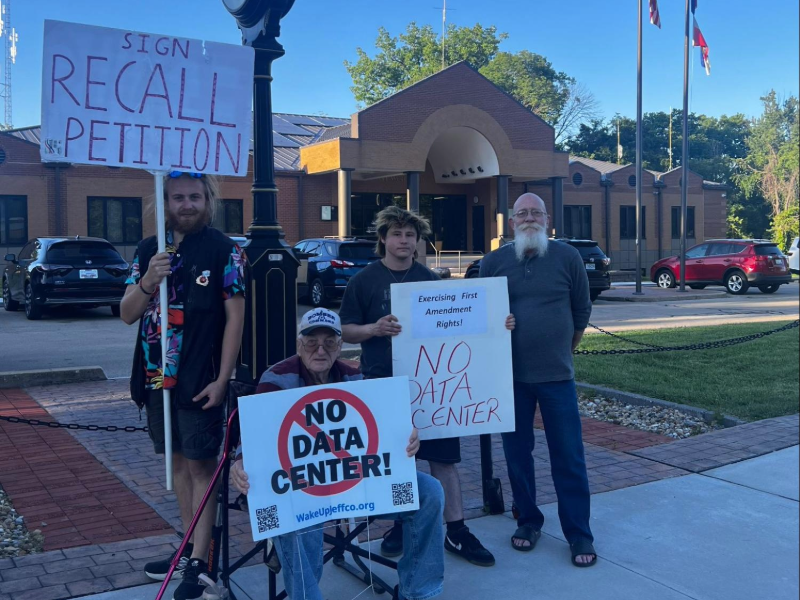
Following a Festus City Council meeting on the evening of May 11th, Air Force veteran Victor Dubbs sat on the sidewalk outside City Hall in a folding chair holding a "No Data Center" sign. "We're not against progress. We want a word. We want them to involve us in the process. They work for us," he told Tech Policy Press.