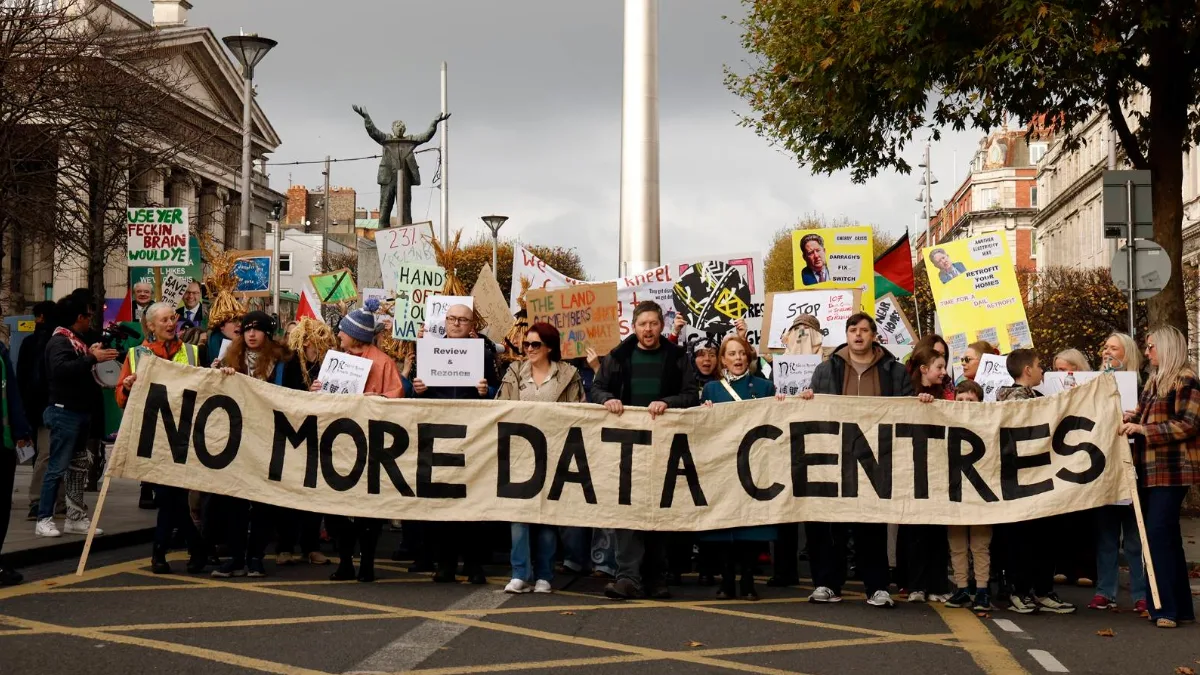
This week, the Irish capital is the venue for two major EU gatherings: the European Political Community Summit and an informal Council meeting, both placing AI sovereignty front and centre. Ireland's rotating presidency of the EU Council has brought heightened security and significant disruption to Dublin, though the city's streets have become a stage for a different kind of political statement.
Thousands of protesters marched through Dublin last weekend to oppose the expansion of data centers, joining demonstrations that stretched from Helsinki to Amsterdam, Paris and Zaragoza under the StopDirtyDatacenters.eu banner. Community groups affected by data center growth demanded a moratorium on large-scale projects, citing concerns about concentrated corporate power and environmental and social harm.
The EU's response points in the opposite direction. Through the Cloud and AI Development Act (CADA), Brussels has committed to tripling data center capacity across Europe within five to seven years. The strategy aims to reduce dependence on United States technology firms by establishing a sovereignty framework for cloud computing, while simultaneously fast-tracking permitting and removing regulatory barriers to expansion. Campaigners argue that what the EU frames as "red tape" represents essential safeguards for public participation under the Aarhus Convention.
This gap between public sentiment and policy direction reflects a broader European disconnect. Data centers have shifted from abstract infrastructure to a doorstep issue for ordinary citizens. Recent polling in the United States showed 56% of respondents cited data centers and AI as "crucial" to their voting decisions in midterm elections, signalling how central these questions have become to public consciousness.
Ireland's pivotal role
Ireland, already hosting more data centers than most European nations, is currently drafting revisions to the CADA framework that critics contend would advantage Big Tech corporations. As Council president until year's end, Ireland effectively controls the negotiating position on this legislation.
The United Nations has identified Ireland as a cautionary example of unchecked AI infrastructure growth. Yet rather than charting a different course, Ireland's proposed amendments push the policy further toward industry preferences. While CADA's stated aim is reducing European reliance on US technology giants, Ireland's counter-proposal weakens the sovereignty framework and lowers qualification thresholds for the same firms to achieve "sovereign" status—demands that industry lobbyists have actively pursued.
Ireland and the AI boom
Ireland positioned itself at the centre of the AI expansion by hosting the AI Summit in Dublin last month. European Commission Executive Vice President Henna Virkkunen told the industry-heavy audience that "more needed to be done to stay in the race."
Ireland's alignment with technology companies is not new. The country has faced repeated criticism for prioritising US tech interests. In October, Ireland's presidency secured a joint Council position on the Digital Omnibus, with 24 of 27 member states backing measures that campaigners warned would expand corporate scope to use personal data for AI training.
The presidency has found itself navigating competing pressures: reliance on major US technology firms, demands from civil society for stronger rules, and criticism from EU partners about weak enforcement. When Ireland assumed the rotating presidency, more than 70 academics called on it to step back from certain digital policy negotiations, citing impartiality concerns. Last week, UN experts cautioned that "regulators must be able to take decisions without undue influence, including from the powerful industries they oversee."
A Corporate Europe Observatory report documented Big Tech's intensified lobbying campaigns ahead of Ireland's presidency. Ireland proceeded to oversee the Digital Omnibus, described as one of the largest deregulation exercises in EU history—changes pursued through sustained industry pressure to weaken fundamental rights protections, reduce democratic oversight, and reframe EU values in the name of competitiveness.
Who controls the fast-tracked capacity?
Ireland faces relentless Big Tech lobbying, but the phenomenon extends across Europe. Research by SOMO examined lobbying meetings with the European Commission and found that the three hyperscalers—Google, Microsoft and Amazon—which together control 70% of Europe's cloud market, held 41 meetings with the Commission between the start of the Commission's 2024 mandate and CADA's announcement.
The influence of this lobbying is visible in CADA's text. One telling example concerns how "public acceptance" of data center projects is framed as something to be managed from above rather than rooted in genuine community consent. Google's submission to the Commission's consultation explicitly recommended that the EU restrict affected communities' right to challenge data center proposals, treating community involvement as an obstacle to be streamlined rather than a legitimate democratic concern.
CADA addresses market concentration as a symptom of Europe's dependence on a small number of providers, proposing accelerated expansion as the remedy. Yet dependence on hyperscalers stems from more than insufficient capacity. The largest providers benefit from economies of scale, entrenched infrastructure, established customer relationships, access to capital and high switching costs—advantages that rapid capacity expansion alone will not diminish.
CADA establishes a sovereignty framework with four assurance levels, with stricter requirements at higher tiers regarding ownership, control and exposure to non-EU law. Ireland's published revisions to the draft text reveal amendments concerning autonomy that appear designed to benefit US Big Tech incumbents. The changes dilute autonomy safeguards intended to prevent American technology firms from accessing higher sovereignty assurance levels, simultaneously lowering entry barriers for US hyperscalers to qualify for accelerated treatment.
If genuine technological sovereignty is the objective, weakening barriers for non-sovereign, third-country providers seems counterintuitive. Instead, the amendments preserve existing arrangements, enabling frictionless market access for dominant US firms in an already heavily concentrated cloud and AI sector. Concentrating vast power in American technology companies contradicts the goal of a sovereign Europe, and Ireland's proposed changes risk undermining Europe's stated sovereignty ambitions.
Who funds it? And at what cost?
Transforming Europe's data center capacity requires resources and infrastructure matched only by global financial capital. Wall Street asset managers including Vanguard and BlackRock are channelling enormous sums into the AI companies driving this expansion, with expectations of rapid returns on investment.
Against a backdrop of intensifying cost-of-living pressures, the economic rationale for this allocation of resources warrants scrutiny. Irish researchers have posed the same question, drawing comparisons between capital committed to data centers—predominantly owned by US technology giants—and alternative uses for those funds. Between 2019 and 2024, equivalent investment could have constructed approximately 50,000 homes in Ireland.
Irish policymakers face a fundamental choice: will they serve the interests of Big Tech or work to reduce Europe's structural dependence on these companies during a period of economic hardship?
And on what terms?
As European leaders convene in Dublin, the voices of protesters in the streets merit serious attention. Their demands challenge the presumption that expanding data center infrastructure automatically serves the public interest.
Ireland's presidency should leverage CADA negotiations to address Europe's structural reliance on Big Tech, rather than simply rebranding that dependence with a sovereignty label. The true measure of CADA should not be the speed of AI infrastructure expansion, but rather who owns and controls it, who stands to gain and who bears the burden. Ireland can choose to keep the door open for incumbent technology giants or help establish Europe's digital future on more democratic foundations, with power distributed more widely than it currently is.