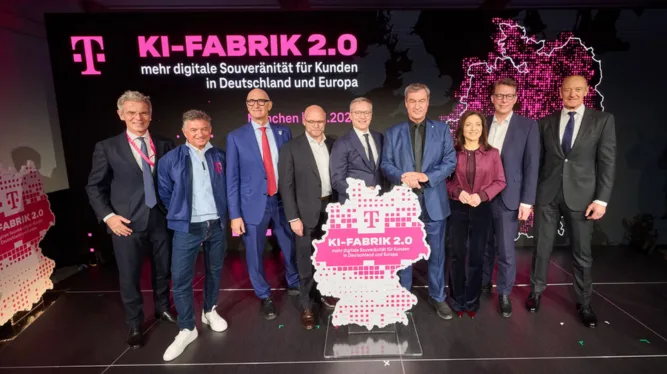
Deutsche Telekom is committing almost €250 million toward scaling up its AI factory located in Munich, aiming to double the facility's computational resources in response to surging demand for artificial intelligence capabilities.
The investment will introduce additional Nvidia Blackwell Ultra B300 GPUs alongside existing infrastructure, raising the facility's total power consumption to 20 megawatts. This expanded capacity will enable enterprises to construct and operate large-scale AI models, execute resource-intensive simulations, and evaluate emerging technologies. The facility will also facilitate physical AI applications, enabling organizations to validate robots, products and manufacturing workflows in simulated settings before real-world deployment.
Deutsche Telekom CEO Tim Höttges emphasized the strategic importance of the expansion: "Germany must not only be a user of AI; it must also create value and prosperity itself. Telekom has moved forward here at a rapid pace. Now we are taking the next step and expanding. So ideas become innovative products, and innovations become growth."
Höttges further outlined the company's vision for European AI infrastructure: "The world must take Europe seriously. Powerful AI emerges from the interplay of computing capacity, secure data spaces, high-performance connectivity, and a sovereign, secure environment. Together with partners from industry, academia, and the public sector, Telekom brings these building blocks together into a European AI ecosystem."
He added that the overarching objective extends beyond mere development: "The goal is not only to develop AI, but to put it into practice as a scalable business model – delivering measurable efficiency gains, new products, and additional value creation in Germany and Europe."
The expansion initiative has garnered backing from senior German government officials and industry stakeholders, who regard artificial intelligence as a critical driver of the nation's industrial competitiveness.
Karsten Wildberger, Federal Minister for Digital Affairs and State Modernisation, praised the company's execution: "Telekom thinks big and acts fast. In just a few months, it went from an idea to operations; after one year, it was fully booked, and now it is doubling capacity. This is exactly the mindset and pace we need to win the AI race for Germany and Europe. The federal government will do its part to help make further successes like this possible."
Katherina Reiche, Federal Minister for Economic Affairs and Energy, highlighted the manufacturing implications: "The next wave of artificial intelligence will fundamentally change the way we manufacture. Germany has a unique competitive advantage in this regard: the process expertise our industry has built up over decades. When we combine this expertise with powerful AI, we create industrial intelligence. To achieve this, our companies need secure, sovereign, and affordable computing power."
Reiche concluded by framing the Munich facility as a model for German industrial transformation: "Here in Munich, Deutsche Telekom is creating exactly these conditions and doubling its capacity to 20,000 graphics processing units. This is entrepreneurial courage that turns technological possibilities into industrial reality. And this is precisely where a major opportunity lies for Germany as a business location."